Buongiorno! I’m Rossana, your Italian teacher, and I’m so excited to start this journey with you.
Since this is your very first lesson (Livello A1), we will start with the building blocks of the language.
To make things easier, I will explain the rules in English, but we will practice the sounds in Italian.
The Italian alphabet
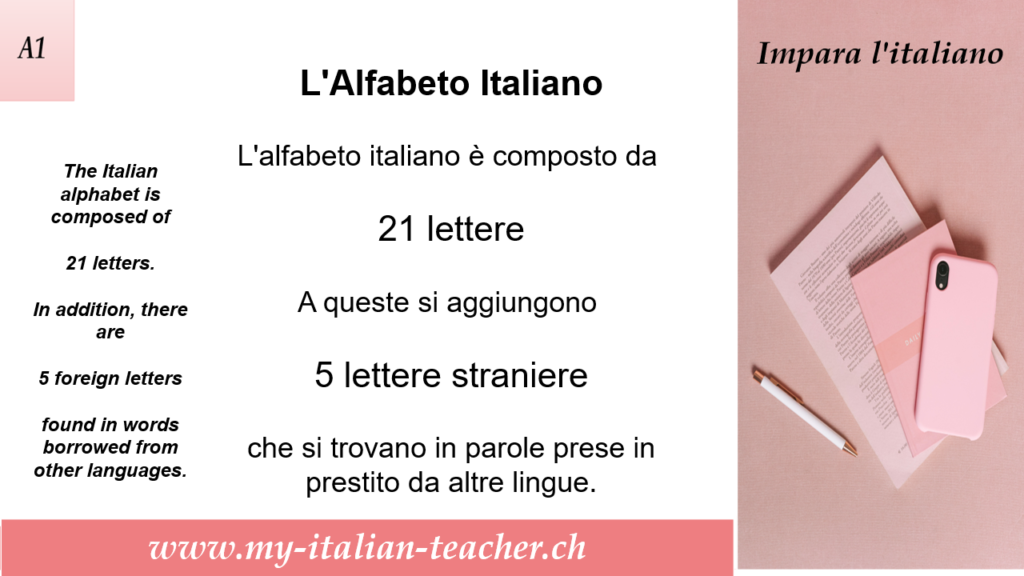
The Italian alphabet is actually shorter than the English one. It consists of 21 letters.
| Letter | Name (Pronunciation) | Example |
| A | Ah | Amore (Love) |
| B | Bee | Bene (Well) |
| C | Chee | Ciao (Hi/Bye) |
| D | Dee | Donna (Woman) |
| E | Eh | Elenco (List) |
| F | Eff-eh | Fame (Hunger) |
| G | Jee | Gatto (Cat) |
| H | Ak-ka | Hotel (Silent!) |
| I | Ee | Italia (Italy) |
| L | Ell-eh | Libro (Book) |
| M | Emm-eh | Mano (Hand) |
| N | Enn-eh | Nome (Name) |
| O | Oh | Ora (Hour) |
| P | Pee | Pane (Bread) |
| Q | Koo | Quadro (Painting) |
| R | Err-eh | Roma (Rome) |
| S | Ess-eh | Sole (Sun) |
| T | Tee | Tavolo (Table) |
| U | Oo | Uscita (Exit) |
| V | Vee/Voo | Vino (Wine) |
| Z | Zeta | Zucchine (Zucchini) |
Note: The letters J, K, W, X, Y exist only in foreign loanwords (like Jeans or Koala).
Listen and read the Italian alphabet and repeat the pronunciation
A. si pronuncia a come Amore
B. si pronuncia Bi come Bene
Ci si pronuncia ci come Ciao
D. si pronuncia di come Donna
E. si pronuncia e come Elenco
F. si pronuncia effe come Fame
G. si pronuncia g come Gatto
H. si pronuncia acca come Hotel
I. si pronuncia i come Italia
L. si pronuncia elle come Libro
M. si pronuncia emme come Mano
N. si pronuncia enne come Nome
O. si pronuncia o come Ora
P. si pronuncia p come Pane
Q. si pronuncia qu come Quadro
R. si pronuncia erre come Roma
S. si pronuncia esse come Sole
T. si pronuncia ti come Tavolo
U. si pronuncia u come Uscita
V. si pronuncia vi come Vino
Z. si pronuncia zeta come Zucchine
Key pronunciation rules
Italian is a phonetic language, meaning it is usually pronounced exactly as it is written. However, there are a few “tricky” consonants you need to know.
The “C” and “G” rule
The sound of C and G changes depending on the vowel that follows them.
- Hard Sound: Followed by A, O, U or H.
- C sounds like “K”: Casa (house), Che (what).
- G sounds like “G” in “Go”: Gatto (cat), Ghetto.
- Soft Sound: Followed by E or I.
- C sounds like “Ch” in “Cheese”: Ciao, Cena (dinner).
- G sounds like “J” in “Joy”: Giro (tour), Gelato.
The silent “H”
In Italian, the letter H is always silent. It is used to keep the “C” or “G” sound hard before E or I.
- Spaghetti (The ‘h’ makes the ‘g’ hard).
- Chitarra (Guitar – sounds like “Kee-tar-ra”).
GLI and GN
These are unique Italian sounds:
- GN: Sounds like the “ny” in “Canyon.”
- Example: Gnocchi, Sogno (dream).
- GLI: This is a liquid “L” sound. Press your tongue against the roof of your mouth. It’s similar to the “lli” in “Million.”
- Example: Famiglia (family), Figlio (son).
3. Vowels (Le vocali)
Unlike English, Italian vowels are short, clear, and never change.
- A: “Ah” (as in Father)
- E: “Eh” (as in Egg)
- I: “Ee” (as in Meet)
- O: “Oh” (as in Orange)
- U: “Oo” (as in Boot)
4. Double consonants (Le doppie)
When you see a double letter (like in Pizza or Mamma), you must linger on that sound a bit longer. It’s like a tiny pause or an extra “beat.”
- Caro (Dear) vs. Carro (Cart/Wagon) — the double “r” makes a big difference!
Quick practice exercise
Try reading these words aloud following the rules above:
- Gelato (Soft G)
- Chitarra (Hard C because of H)
- Bagno (The GN sound)
- Zucchero (Hard C + Double C)
Pingback: Gender and number of nouns in Italian - My Italian teacher