By Rossana Pazzaglia, native Italian teacher with a CEDILS certification in teaching Italian to foreigners (Ca’ Foscari University of Venice) · Updated 19 October 2026
Masculine or feminine? Singular or plural? In lesson 1 we worked on the alphabet and pronunciation. Now we take the next step: every Italian noun has a gender and a number, and most of the time the ending gives it away. Here is how to read the clues, and where the traps are.
In two minutes
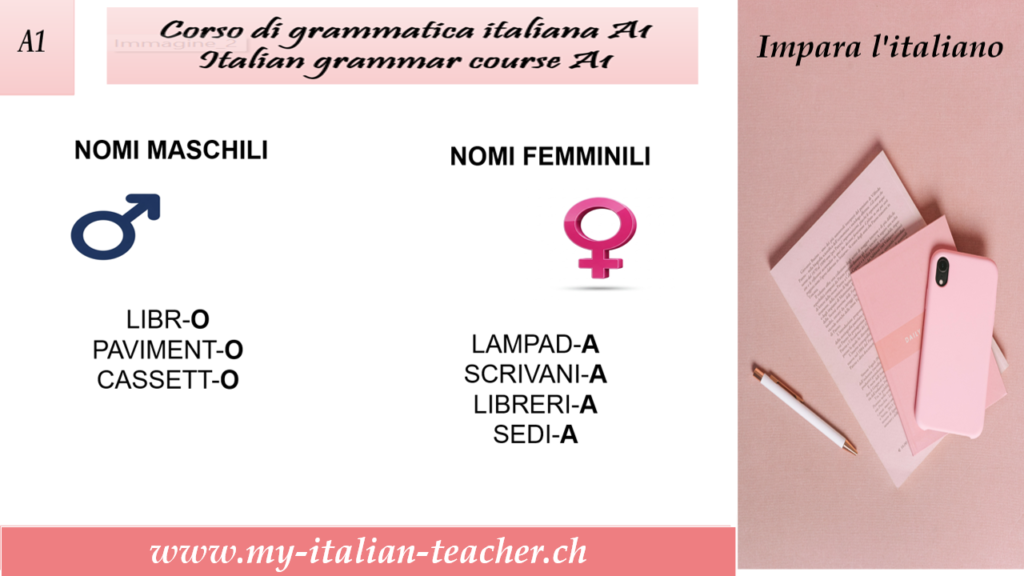
- Nouns in -o are usually masculine (plural -i).
- Nouns in -a are usually feminine (plural -e).
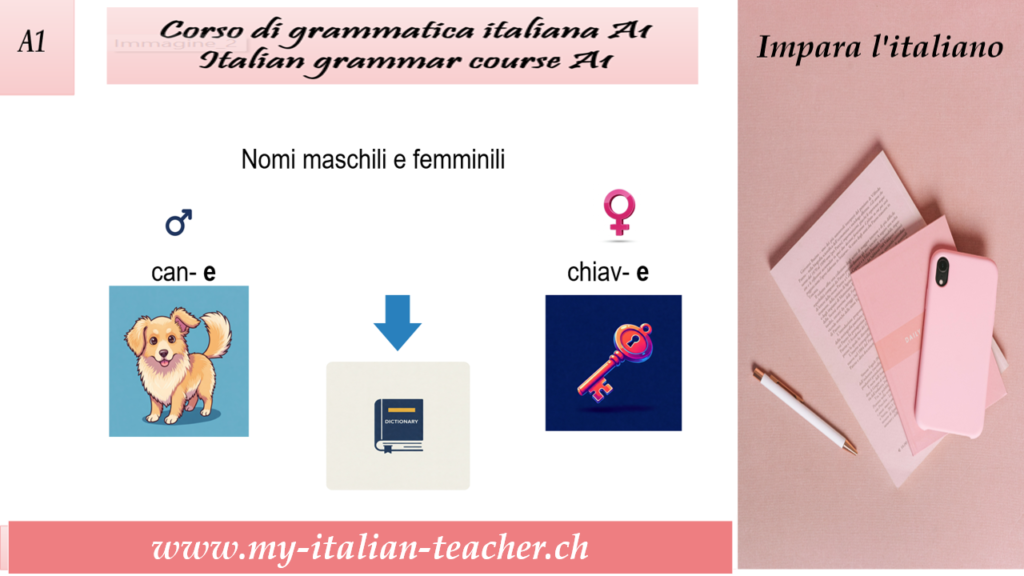
- Nouns in -e can be either (plural -i): check the dictionary.
- Words with a final accent, short words and foreign words don’t change in the plural.
- Always learn a noun together with its article.
Contents
Watch the video lesson
The rules in short
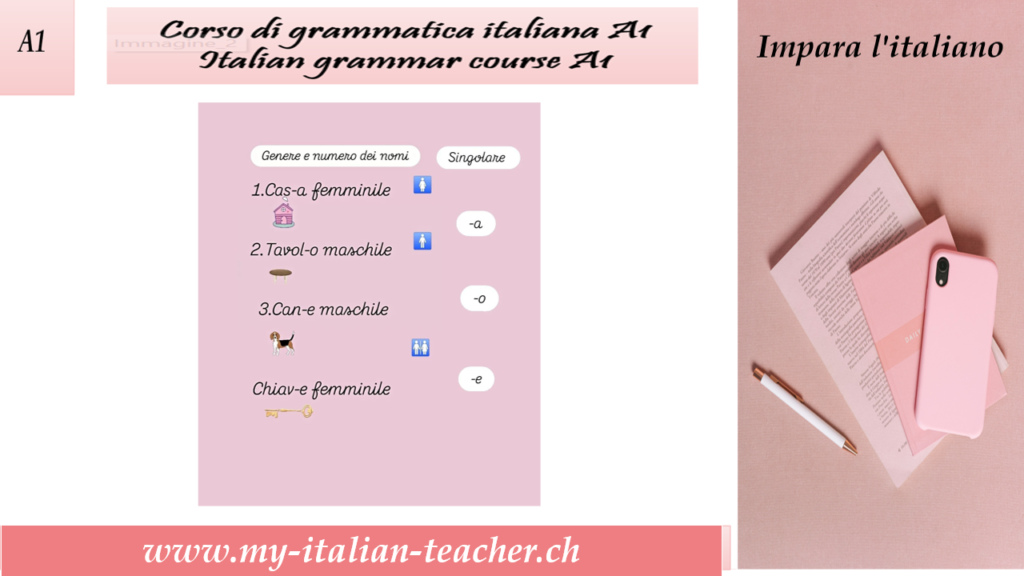
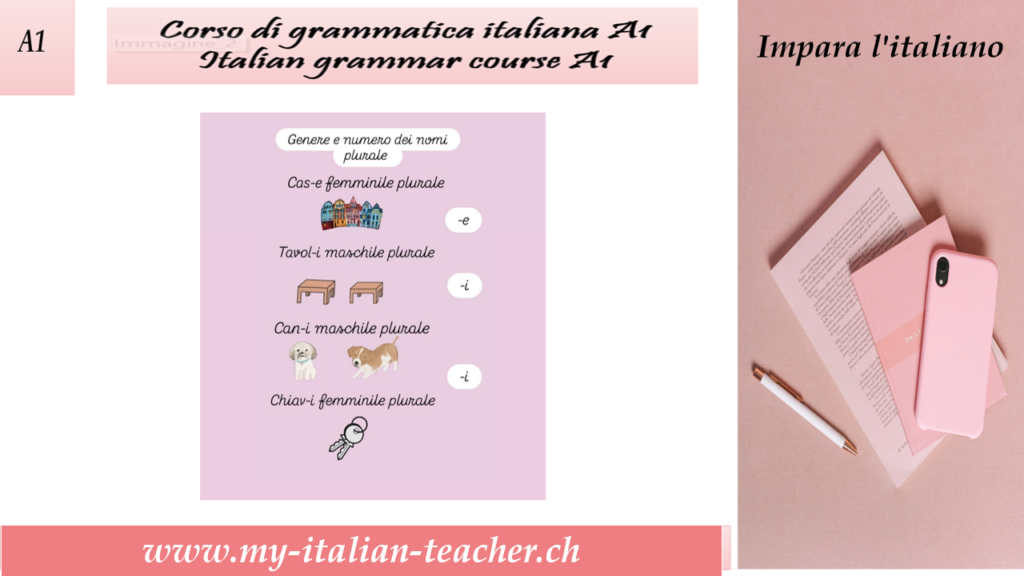
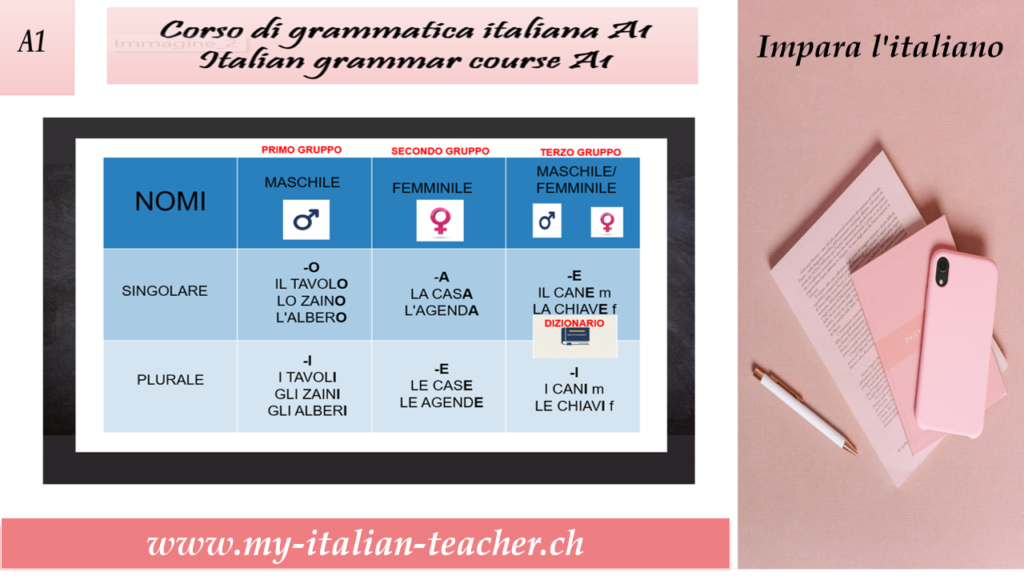
In Italian every noun is either masculine or feminine, and the ending usually tells you which one. The ending also changes from singular to plural. There are three main groups:
| Singular | Plural | Examples | |
|---|---|---|---|
| Masculine in -o | -o | -i | il tavolo → i tavoli; lo zaino → gli zaini |
| Feminine in -a | -a | -e | la casa → le case; l’agenda → le agende |
| Masculine or feminine in -e | -e | -i | il cane → i cani; la chiave → le chiavi |
Nouns ending in -e: check the dictionary
Nouns ending in -e can be masculine (il cane, the dog) or feminine (la chiave, the key). The ending doesn’t tell you the gender: look it up in the dictionary, where you will find m. (masculine) or f. (feminine), and learn the noun together with its article.
Watch out for a few exceptions
- la mano → le mani (the hand is feminine, even if it ends in -o)
- il problema → i problemi (masculine, even if it ends in -a)
- la foto → le foto, il caffè → i caffè (shortened words and words with a final accent do not change)
More clues to recognise the gender
Besides -o and -a, some other endings give you a useful hint. Learn them as patterns: they will help you every time you meet a new word.
- -zione / -sione → almost always feminine: la stazione (the station), la lezione (the lesson), la televisione. Plural in -i: le stazioni, le lezioni.
- -tà / -tù → feminine and invariable: la città → le città, l’università → le università, la virtù → le virtù.
- -ore → usually masculine: il colore, il fiore, il dottore. Plural in -i: i colori, i fiori.
- -ista → masculine or feminine, depending on the person: il turista / la turista. The plural changes: i turisti (masculine), le turiste (feminine).
- Words from other languages → usually masculine and invariable: il bar → i bar, il computer → i computer, lo sport → gli sport.
People: masculine and feminine forms
For people and many animals, Italian often has two forms. The most common pattern is -o / -a: il ragazzo / la ragazza (boy / girl), l’amico / l’amica (friend). Some nouns in -e have a feminine in -essa: lo studente / la studentessa, il professore / la professoressa. And some pairs are completely different words: l’uomo / la donna (man / woman), il padre / la madre (father / mother).
Plurals that need an extra letter: -ca, -ga, -co, -go
To keep the hard sound /k/ or /g/ in the plural, Italian often adds an h (remember lesson 1: the H keeps C and G hard):
- Feminine nouns in -ca / -ga → -che / -ghe: l’amica → le amiche, la riga → le righe.
- Many masculine nouns in -co / -go → -chi / -ghi: il parco → i parchi, il lago → i laghi.
- Other nouns go soft instead: il medico → i medici and l’amico → gli amici. The Treccani grammar gives a guideline: words stressed on the second-to-last syllable (parco, lago) usually take -chi / -ghi, and words stressed on the third-to-last (medico) usually take -ci / -gi. But it is a tendency, not a law, and amico is a famous exception. When in doubt, check the dictionary.
Write every noun with its article
Never write a new noun alone in your notebook. Write it with its article (la chiave, il cane, l’università) and, when it is irregular, with its plural too (la mano – le mani). This way gender and number become automatic, and you will need them in the next lessons, when we match articles and adjectives to the noun.
Nouns that do not change in the plural
The Treccani Encyclopedia of Italian lists the nouns that keep the same form in the singular and in the plural. For a beginner, these four groups are the most useful:
- Words of one syllable and words ending in a stressed vowel: il re → i re (the king), la virtù → le virtù, la città → le città.
- Foreign words and shortened words: il caffè → i caffè, il film → i film, lo sport → gli sport, la bici → le bici, la moto → le moto.
- Some nouns in -ie or -i: la specie → le specie, la serie → le serie, il brindisi → i brindisi (the toast).
- A few “odd couples”: il panda → i panda (masculine in -a), la radio → le radio (feminine in -o).
With these nouns, only the article tells you the number: il caffè is singular, i caffè is plural. One more reason to always learn the noun with its article.
Irregular plurals you will meet very soon
Some of the most common A1 words are irregular. Learn them as small “families”:
| Singular | Plural | Note |
|---|---|---|
| l’uomo (man) | gli uomini | The plural ends in -i like a regular one, but the stem changes: uom- → uomin-. |
| la mano (hand) | le mani | Feminine, although it ends in -o. |
| l’uovo (egg) | le uova | Masculine singular, feminine plural in -a. |
| il paio (pair) | le paia | Masculine singular, feminine plural in -a. |
| il braccio (arm) | le braccia | I bracci is used for figurative meanings, for example the arms of a lamp. |
| il dito (finger) | le dita / i diti | Le dita = the fingers of a hand as a set. I diti = individual fingers (i diti indici). |
Don’t worry if you can’t memorise them all today. Come back to this table every time you meet one of these words in a text or a conversation. If you want to go deeper, there is a whole lesson on irregular plurals.
Common mistakes
- “le mano” instead of le mani. Mano is feminine, but its plural is in -i.
- “i città” instead of le città. The noun doesn’t change, but its article does, and it stays feminine.
- “la problema” instead of il problema. Problema ends in -a but is masculine: il problema, i problemi. The same applies to il programma, il sistema, il tema, which come from Greek.
- Translating the gender from your own language. The sun is masculine in Italian (il sole) and in French (le soleil), but feminine in German (die Sonne). The moon is feminine in Italian (la luna) but masculine in German (der Mond). Don’t trust your first language: check each noun.
Practice with answers
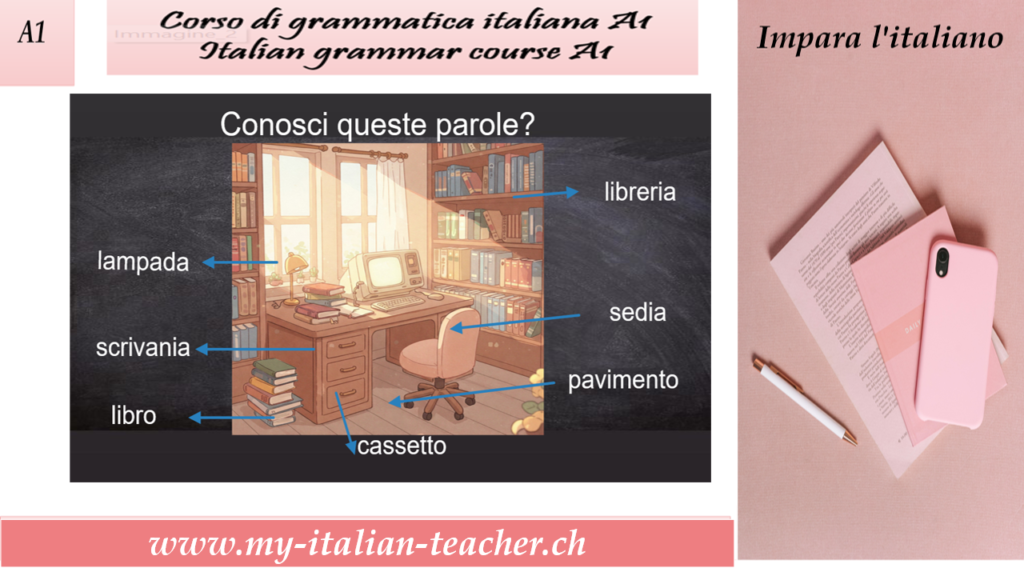
1. Make these nouns plural: il libro, la sedia, la lampada, il pavimento, la chiave, il cane.
Show the answers
i libri, le sedie, le lampade, i pavimenti, le chiavi, i cani.
2. Masculine or feminine? Then write the plural: stazione, città, colore, turista (a woman), sport, amica, parco, problema.
Show the answers
la stazione → le stazioni; la città → le città; il colore → i colori; la turista → le turiste; lo sport → gli sport; l’amica → le amiche; il parco → i parchi; il problema → i problemi.
📚 Want more exercises like these?
Gender and plurals become automatic only with repetition. If you finished the two exercises above and want more, with an answer key to correct yourself, I recommend:
- Italian Grammar in Practice (Susanna Nocchi, Alma Edizioni): the rules explained in English, with short exercises, tests and games.
- Practice Makes Perfect: Complete Italian All-in-One (Marcel Danesi, McGraw Hill): grammar and vocabulary in one workbook, with plenty of exercises on nouns and articles.
Affiliate links · As an Amazon Associate I earn from qualifying purchases.
The lesson slides
Show the 7 slides of the video lesson
Sources
- Treccani, Enciclopedia dell’Italiano: “Plurale” (accessed 16 October 2026)
- Treccani, La grammatica italiana: “Nomi” (accessed 16 October 2026)
- Treccani, La grammatica italiana: “-co, -go, plurale dei nomi in” (accessed 16 October 2026)
- Treccani, La grammatica italiana: “Diti o dita?” (accessed 16 October 2026)
Continue the course
- Lesson 1: the Italian alphabet and pronunciation
- Lesson 3: definite and indefinite articles
- Lesson 0: introduction to the free A1 grammar course
Wondering whether A1 is really your level? Check with the free Italian level test.
💡 Want to learn Italian with a complete path?
I am preparing a series of Italian courses from A1 to C2, with clear lessons, exercises and a step-by-step method. 👉 Join the waiting list and you will be among the first to know when they open.