🇮🇹 Leggi questo articolo in italiano
By Rossana Pazzaglia, native Italian teacher with a CEDILS certification in teaching Italian to foreigners (Ca’ Foscari University of Venice) · Updated 19 October 2026
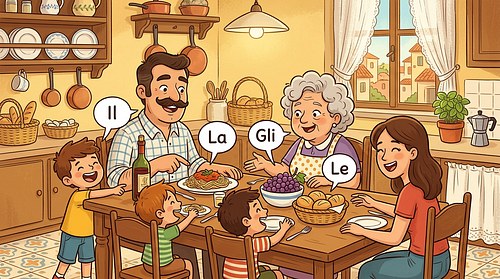
English has one “the” and basically one “a”. Italian articles, on the other hand, change according to gender, number and even the first sound of the next word. It looks complicated, but the logic is simple, and once you see it in real sentences it becomes natural: grammar is learned far better in context than by heart. That’s why, next to the tables, you’ll find two short scenes, one in a shop and one at the station (A1-A2 level).
Definite articles (the)
Use them for something specific or already known: il libro che mi hai prestato (the book you lent me), la casa di Marco (Marco’s house).
| Singular | Plural | When | |
|---|---|---|---|
| Masculine | il libro | i libri | before a consonant |
| lo studente, lo zaino | gli studenti, gli zaini | before s + consonant, z, gn, ps, pn, x, y | |
| l’amico | gli amici | before a vowel | |
| Feminine | la casa | le case | before a consonant |
| l’amica | le amiche | before a vowel |
Indefinite articles (a, an)
Use them for something general or mentioned for the first time: ho comprato un libro (I bought a book), cerco una casa (I’m looking for a house). They have no plural: in the plural Italian usually uses dei, degli, delle (“some”), which we’ll look at further down this page.
| Form | When | |
|---|---|---|
| Masculine | un libro, un amico | before a consonant or a vowel |
| uno studente, uno zaino | before s + consonant, z, gn, ps, pn, x, y | |
| Feminine | una casa | before a consonant |
| un’amica | before a vowel |
The practical rule: listen to the sound
To choose the article, look at how the next word begins. The “difficult” combinations (s + consonant, z, gn, ps, pn, x, y) always take lo / gli / uno. All other consonants follow the basic rule: il / i / un.
Careful: the article agrees with the word that comes right after it, even if it’s an adjective: lo zio but il vecchio zio; l’amico but il mio amico.
The most common mistakes
- “un’amico”: wrong! The apostrophe is only used in the feminine: un amico, un’amica.
- “il studente”: before s + consonant you need lo studente.
- “i amici”: before a vowel the masculine plural is gli amici.
- Leaving the article out: Italian uses it much more than English, for example for things in general (il caffè è buono, coffee is good) and with possessives (la mia casa, my house).
One exception to remember: il dio (the god), but in the plural gli dèi.
How to remember them
Learn every new noun together with its article: not “casa” but “la casa”; not “problema” but “il problema”. This way you also learn the gender, which you can’t always guess from the ending. Review the rules on gender and number of nouns.
Checking the Rules Against a Reference Grammar
The forms above match those given by Treccani’s Enciclopedia dell’italiano: lo appears before z, x, semiconsonantal i, s + consonant, sc, gn, ps; il before other consonants; l’ before a vowel. For the masculine indefinite article, uno is used in the same cases as lo, and un in the others [1]. For “semiconsonantal i” think of words like lo iodio or lo yogurt, where i / y sounds like a consonant.
When the Article Is Not Used
- With singular family nouns after a possessive: mia madre, tuo fratello (but le mie sorelle in the plural).
- In many expressions of place and state: vado a casa, sono in ufficio, parlo con Marco.
- With city names: vivo a Lugano.
- When addressing someone directly with a title: Buongiorno, signora Rossi (but la signora Rossi è arrivata when talking about her).
Mini-Dialogue: In a Shop
Cliente: Buongiorno, cerco uno zaino per mio figlio.
Commessa: Certo! Questo è lo zaino più venduto, oppure c’è un modello più piccolo.
Cliente: Prendo l’altro, per favore. E anche un’agenda e gli auricolari.
Exercise 1
Choose the right definite article:
- ___ zucchero (sugar)
- ___ ospedale (hospital)
- ___ sedia (chair)
- ___ gnocchi
- ___ psicologo (psychologist)
- ___ amiche (female friends)
- ___ treni (trains)
- ___ isola (island)
Answers: 1. lo – 2. l’ – 3. la – 4. gli – 5. lo – 6. le – 7. i – 8. l’.
Exercise 2: The Indefinite Article
Complete with un, uno, una, un’:
- Ho ___ idea fantastica.
- Cerco ___ appartamento in centro.
- Marco ha ___ zio a Roma.
- Vorrei ___ spremuta d’arancia.
- Mi serve ___ psicologo bravo.
Answers: 1. un’ – 2. un – 3. uno – 4. una – 5. uno.
Think about it: choose five objects in your room and write each with the correct article, singular and plural.
Some: the Partitive Article (dei, degli, delle)
As we said, the indefinite article has no plural. When you want to say “some” of something, Italian combines di with the definite article: ho comprato delle mele (I bought some apples), abbiamo degli amici a Zurigo (we have some friends in Zurich), c’è del pane? (is there any bread?). According to Treccani’s La grammatica italiana, this “partitive article” indicates an indefinite part of a whole, an imprecise quantity; in the plural it works as the plural of un, uno and una [2].
One limit worth knowing already: the same source notes that the plural partitive is not used after di and da, where Italian prefers alcuni / alcune: ho bisogno di alcuni chiodi, not “di dei chiodi”. For now, just learn the basic idea and the forms dei / degli / delle.
A First Look at Articulated Prepositions
You have probably already met words like al, nel or della. They are preposizioni articolate: a simple preposition fused with a definite article. Treccani explains that the prepositions which combine with the article are di, a, da, in, con, su and per; tra and fra stay separate (tra i libri, among the books) [3]. For A1-A2 the most useful ones are these:
| Preposition | + il | + lo / l’ | + la | + i | + gli | + le |
|---|---|---|---|---|---|---|
| di | del | dello / dell’ | della | dei | degli | delle |
| a | al | allo / all’ | alla | ai | agli | alle |
| da | dal | dallo / dall’ | dalla | dai | dagli | dalle |
| in | nel | nello / nell’ | nella | nei | negli | nelle |
The good news: the choice of article does not change, you just glue it to the preposition. Lo zaino becomes nello zaino, l’amica becomes all’amica. The same source adds that the fused forms of con and per are less and less used today; col and coi are the main survivors [3]. So say con il libro without worry.
Careful and Everyday Italian: the Case of pn-
Some learners ask: do native speakers really say lo pneumatico? The Accademia della Crusca answers that both il pneumatico and lo pneumatico exist, but the first belongs to a more familiar register, while lo pneumatico, uno pneumatico, gli pneumatici are the choice for monitored, formal usage [4]. For you, the safe strategy at A1-A2 is simple: follow the table above and you will always be correct.
Days of the Week and Possessives
- Days: il martedì means “on Tuesdays” (every week), while a day without article means the coming one: ci vediamo martedì (see you on Tuesday). Treccani’s Enciclopedia dell’italiano describes exactly this contrast [1].
- Possessives: la mia borsa, il tuo telefono, i nostri amici. The article stays, except with singular family members (mia madre, as seen above).
Mini-Dialogue 2: At the Station
Anna: Scusi, a che ora parte il treno per Milano?
Impiegato: Parte alle dieci e un quarto, dal binario 4.
Anna: E dov’è l’uscita? Ho uno zaino pesante e delle valigie.
Impiegato: Esca dalla porta a sinistra: trova un ascensore vicino all’edicola.
Can you spot the four articulated prepositions (alle, dal, dalla, all’) and the partitive (delle valigie)?
Exercise 3: Prepositions and “Some”
Complete with the correct form:
- Vado ___ (a + il) cinema stasera.
- Il libro è ___ (di + la) professoressa.
- Compro ___ (some) mele al mercato.
- Ho ___ (some) amici a Zurigo.
- Esco ___ (da + lo) studio alle sei.
- Le chiavi sono ___ (in + lo) zaino.
Answers: 1. al – 2. della – 3. delle – 4. degli – 5. dallo – 6. nello.
Questions to Reflect On
- Which of the three sounds (consonant, vowel, s + consonant) do you find hardest to hear? Record yourself reading ten nouns aloud.
- Does your own language use articles? How does that help or confuse you in Italian?
- Look at a menu or a shop sign: how many articles and articulated prepositions can you find?
Keep learning
Want to practise with someone who corrects you straight away? Book a free trial lesson, join the course waiting list or take the free level test.
Sources
- [1] Nicola Grandi, “Articolo”, Enciclopedia dell’Italiano, Treccani (accessed 6 October 2026)
- [2] “Partitivo, articolo”, La grammatica italiana, Treccani (accessed 6 October 2026)
- [3] “Preposizioni”, La grammatica italiana, Treccani (accessed 6 October 2026)
- [4] “Il pneumatico / lo pneumatico”, Consulenza linguistica, Accademia della Crusca (accessed 6 October 2026)
📚 Il, lo or l’? Practise like this
Articles only become automatic with lots of short exercises, repeated often. To practise on your own, with an answer key to check yourself, I recommend:
- Italian Grammar in Practice (Susanna Nocchi, Alma Edizioni) – rules explained in English, with exercises, tests and games.
- Practice Makes Perfect: Complete Italian All-in-One (Marcel Danesi, McGraw Hill) – grammar and vocabulary in one workbook, with plenty of exercises.
Affiliate links · As an Amazon Associate I earn from qualifying purchases.
💡 Want to learn Italian with a complete path?
I am preparing a series of Italian courses from A1 to C2, with clear lessons, exercises and a step-by-step method. 👉 Join the waiting list and you will be among the first to know when they open.