This article opens the blog’s series on Raphael: ten works to discover the Italian Renaissance and, at the same time, to practise advanced Italian. If you want to learn the language through art, you can book a private online lesson or join the course waiting list at my-italian-teacher.ch.
The artwork at a glance
- Artist: Raffaello Sanzio, known as Raphael (Urbino 1483 – Rome 1520)
- Title: The Marriage of the Virgin (Lo Sposalizio della Vergine)
- Date: 1504 (signed and dated)
- Medium and size: oil on panel, 170 × 117 cm
- Original location: Chapel of Saint Joseph (Albizzini family), church of San Francesco, Città di Castello
- Current location: Pinacoteca di Brera, Milan
A 21-year-old signs his manifesto
Raphael’s Marriage of the Virgin is one of the most studied paintings in Italian art history, and not only for its beauty. It is the first major work the young painter signs and dates in a monumental way: on the frieze of the temple portico, above the central arch, we read RAPHAEL URBINAS, “Raphael of Urbino”, and just below the date in Roman numerals, MDIIII, that is 1504. Raphael was twenty-one.
The signature matters, because the painting was created in direct dialogue with a work on the same subject by his master, Pietro Vannucci, known as Perugino, who in those very years was completing a Marriage of the Virgin for Perugia Cathedral. By placing his name at the very heart of the composition, on the temple, Raphael declares his artistic identity. The comparison between the two panels has become a textbook classic: it is the moment when, according to a long critical tradition going back to Giorgio Vasari, the pupil begins to surpass the master.
We’ll start with the young painter’s training, then look closely at the perspective, the temple and the story being told. At the end there is an Italian workshop with a glossary and exercises on comparing, aimed at anyone preparing the CILS or CELI writing paper (B2-C1).
1. The context: from Urbino to Perugino’s workshop
Raphael’s training in Urbino
Raphael was born in Urbino in 1483, the son of the painter and man of letters Giovanni Santi, who worked at the court of the Montefeltro family. Federico da Montefeltro’s city was one of the most refined centres of the fifteenth century: in the Ducal Palace designed by Luciano Laurana and in the works of Piero della Francesca, the mathematical culture of perspective had become the language of the court. In this environment the young Raphael absorbed a taste for measured space and for centrally planned architecture.
Raphael and Perugino
Vasari tells us that Raphael’s father took the boy to Perugia, to the workshop of Perugino, then one of the most sought-after painters in Italy. Modern scholars still debate the exact nature of this relationship (pupil, assistant or young associate), but it is certain that in the first years of the sixteenth century Raphael’s style was extremely close to his master’s. Vasari himself observes that some of the early works, without the signature, would have been taken for paintings by Pietro.
Two versions of the same subject
Perugino worked on his Marriage of the Virgin for the Chapel of the Holy Ring in the Cathedral of San Lorenzo in Perugia between 1501 and 1504. The link with the cathedral was very strong, because it houses the relic that tradition identifies as the Virgin’s wedding ring. Requisitioned by Napoleon’s troops in 1798, the panel is now in the Musée des Beaux-Arts in Caen, Normandy. Raphael received the commission for Città di Castello from the Albizzini family. He took up his master’s subject and general layout, but transformed them profoundly.
2. Raphael and Perugino: the differences in a table
| Element | Perugino (Caen, 1501–1504) | Raphael (Brera, 1504) |
|---|---|---|
| Temple | Octagonal and massive, with projecting porches | Sixteen-sided, almost circular, lightened by an arcaded portico on columns |
| Viewpoint | Lower; the temple weighs on the scene | Raised; the square opens up and the temple becomes the focus of the space |
| Arrangement of figures | Lined up in a horizontal band in the foreground | Arranged along a gentle curve that echoes the shape of the temple |
| High priest | Perfectly vertical and symmetrical, a rigid axis | Slightly tilted, a dynamic pivot between Joseph and Mary |
| Figures and architecture | Two separate layers | Bound together by the same geometry |
The table summarises observations that recur in the scholarly literature and in the educational materials of the Pinacoteca di Brera itself. The decisive difference is not a single element but the relationship between the parts: in Perugino the architecture is a stage backdrop; in Raphael figures, square and temple form a single organism.
3. The painted architecture: an almost perfect temple
The central plan and the circle
Raphael’s temple has sixteen sides: a polygon that, seen from a distance, approaches the circle, the figure that Renaissance culture considered perfect. A ring of arches supported by slender columns surrounds the central body, which is crowned by a dome. Technical examinations cited in the Lombardy regional heritage catalogue have also shown that the painter changed some details while working, a sign of careful design.
The dialogue with Bramante
Many scholars have noted the similarity between the painted temple and the Tempietto of San Pietro in Montorio, which Donato Bramante, also from the Marche region, was designing and building in Rome in the first years of the century. We do not know whether Raphael had seen drawings of that project. It is wiser to speak of a shared architectural culture, nourished by the same ancient models and treatises, rather than of a direct quotation.
Perspective and meaning
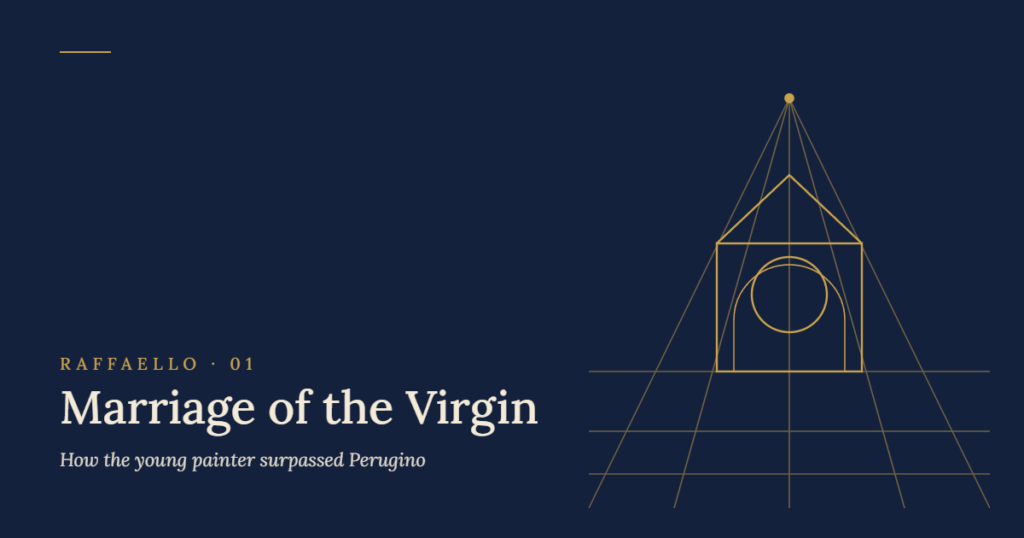
The lines of the large paving slabs in the square converge towards the door of the temple. Beyond the open door we glimpse another open door, through which the sky shines. The vanishing point thus falls at the centre of the building, and the viewer’s eye is led from the ceremony in the foreground to the infinity of the landscape. A widespread theological reading sees the temple as an image of the Church and the open door as a passage towards a spiritual dimension. It should be presented as an interpretation, not as the painter’s documented intention.
4. The subject: the story of the rods
The scene comes from apocryphal accounts and from the Golden Legend by Jacobus de Voragine, the medieval collection of saints’ lives. According to tradition, the high priest of Jerusalem asked Mary’s suitors to come to the temple with a dry rod: only Joseph’s blossomed, a sign of divine choice. Raphael shows the moment when Joseph places the ring on Mary’s finger. The women stand on the left, the disappointed suitors on the right; one of them breaks his rod over his knee, a gesture of irritation that brings a touch of everyday life into the solemn scene.
The faces vary, the costumes differ, the poses alternate: Raphael achieves a naturalness that Perugino’s more compact group lacks. It is precisely this grace (grazia), a key word in criticism of Raphael from Vasari onwards, that made the painting a model for centuries.
5. A turning point in Raphael’s career
In the Marriage of the Virgin Raphael still uses Perugino’s vocabulary, but he changes the grammar: the same subject and similar figures, now arranged in a single space where architecture and people are no longer two separate layers. The signature on the temple is also a bold statement of professional ambition for such a young painter. Shortly after 1504 Raphael moved to Florence, where he would meet Leonardo and Michelangelo, the subject of the next article in the series.
If you are in Milan, you can see the painting at Brera. On the blog you will also find a podcast episode on the gallery: the Pinacoteca di Brera in Milan.
6. Italian language workshop (B2-C1)
Glossary of architecture and perspective
- Pianta centrale (central plan): a building organised around a centre, circular or polygonal.
- Peristasi (peristasis): a ring of columns surrounding a building.
- Fregio (frieze): the horizontal band above the columns, often decorated or inscribed.
- Punto di fuga (vanishing point): the point where perspective lines converge.
- Linea dell’orizzonte (horizon line): the ideal line at the viewer’s eye level.
- Pala d’altare (altarpiece): a painting made for the altar of a church or chapel.
Grammar: how to compare in Italian
To describe two works in a reasoned way, written Italian uses connectives that express contrast or comparison:
- mentre + indicative (“whereas”): Perugino allinea le figure, mentre Raffaello le dispone in curva.
- a differenza di + noun (“unlike”): A differenza del maestro, Raffaello rialza il punto di vista.
- se da un lato… dall’altro (“on the one hand… on the other”): Se da un lato il soggetto è lo stesso, dall’altro la composizione cambia radicalmente.
- laddove (formal, “whereas”): Il tempio di Perugino è ottagonale, laddove quello di Raffaello ha sedici lati.
- rispetto a (“compared with”): Rispetto alla tavola di Caen, quella di Brera è più ariosa.
Exercise
Join each pair of Italian sentences using the connective in brackets.
- Il sacerdote di Perugino è verticale. Il sacerdote di Raffaello è inclinato. (mentre)
- Perugino colloca il tempio dietro le figure. Raffaello lega figure e tempio. (a differenza di)
- La scena è un rito solenne. Un pretendente spezza il ramo con rabbia. (se da un lato… dall’altro)
Answers: 1. Il sacerdote di Perugino è verticale, mentre quello di Raffaello è inclinato. 2. A differenza di Perugino, che colloca il tempio dietro le figure, Raffaello lega figure e tempio. 3. Se da un lato la scena è un rito solenne, dall’altro un pretendente spezza il ramo con rabbia.
Writing task
Write 150-180 words in Italian comparing two artworks (or two buildings) in your city, using at least four connectives from the list. It is excellent practice for the CILS and CELI writing papers.
From pupil to master
Standing in front of the Marriage of the Virgin, you can see what it means to learn from a master and then go your own way. For learners of Italian it is also a very good text for practising description and comparison. If you would like to work on these texts with a guide, you can book a one-to-one online lesson at my-italian-teacher.ch. The courses are not online yet: the waiting list is open. The A1 grammar course is already available for free on the blog.
Recommended reading and resources
- Giorgio Vasari, Lives of the Most Excellent Painters, Sculptors, and Architects (Life of Raphael). View on Amazon
- Konrad Oberhuber, Raphael: The Paintings, Prestel. View on Amazon
- Roger Jones, Nicholas Penny, Raphael, Yale University Press. View on Amazon
As an Amazon Associate, this site earns from qualifying purchases. The price for buyers does not change.
Sources
- Pinacoteca di Brera, Education Services, DescriVedendo: Raphael’s Marriage of the Virgin (room 24)
- Regione Lombardia, Lombardia Beni Culturali, SIRBeC record RL480-00072
- Italian Ministry of Culture, General catalogue of cultural heritage, record ICCD3307334
- Edizioni Ca’ Foscari, “Ai margini di Raffaello. Note sulla cornice neoclassica dello Sposalizio della Vergine” (technical data)
- Finestre sull’Arte, The Marriage of the Virgin, Perugino’s masterpiece, temporarily returns to Italy
- Giorgio Vasari, Life of Raphael, English translation online

