🇮🇹 Leggi questo articolo in italiano
By Rossana Pazzaglia, native Italian teacher with a CEDILS certification in teaching Italian to foreigners (Ca’ Foscari University of Venice) · Updated 19 October 2026
You have studied hard, you can handle the subjunctive and you passed your practice test. Then you arrive in Naples, Milan or Palermo, order a coffee and… you understand half of what people say. Does this sound familiar? You are not alone. Italian courses and coursebooks are mostly based on standard Italian, the language of writing, national media and formal communication, while the language you hear in the street is full of regional variation. It isn’t your fault, and it isn’t your coursebook’s fault either: it’s simply Italy, with all its voices.
Standard Italian vs. real-life Italian
Standard Italian is a very good tool: it is the common language that lets you communicate with anyone in any region, and it is what you need in professional, academic and bureaucratic contexts. Its historical basis is educated Florentine, the language of Dante and later promoted as a national model by writers such as Alessandro Manzoni. But Italy unified relatively late, and for centuries people spoke mainly their local dialects. Today almost everyone speaks Italian, yet regional Italian (italiano regionale) is the form most people actually use: standard grammar coloured by local pronunciation, vocabulary and expressions.
It is important to know that Italian dialects are not just “accents” or “bad Italian”. They developed from Latin in parallel with Tuscan, and many are very different from Italian: a speaker of Sicilian, Venetian or Neapolitan can use words, sounds and grammar that an Italian from another region would not understand without having learned them.
What the data say: Italian and dialects today
According to the most recent ISTAT survey on the use of Italian, dialects and other languages (data for 2024), 53.6% of people aged 6 and over speak only or mainly Italian in the family, compared with 45.9% in 2015. Those who speak only or mainly dialect in the family are 9.6%, compared with 32% at the end of the 1980s. With strangers, Italian dominates even more clearly: 82.6% speak only or mainly Italian. About 7.7% use other languages in the family, a sign of how many people with a migration background now live in Italy.
In practice this means that you will always be understood in standard Italian, but you will often hear dialect words and expressions mixed into conversation, especially among family and friends, in smaller towns and among older speakers.
Italy also officially protects twelve historical linguistic minorities (Law 482/1999): Albanian, Catalan, Croatian, French, Francoprovencal, Friulian, Germanic, Greek, Ladin, Occitan, Sardinian and Slovenian, spoken in specific areas in different regions. In some places, being Italian-speaking is only part of the linguistic picture.
Five differences the exam won’t teach you
1. Regional vocabulary
The same object can have different names depending on where you are:
- watermelon: anguria (northern Italy), cocomero (Rome and central Italy), melone d’acqua (southern Italy and Sicily);
- the croissant-like pastry: cornetto in Rome and in much of Italy, brioche in Milan and the north;
- the bread roll: michetta in Milan, rosetta in Rome.
Food words are especially varied, and the same dish name can indicate different things: the focaccia of Liguria is not the same as the focaccia of Puglia.
2. Pronunciation and intonation
The melody of the language changes from region to region: speed, rhythm and intonation in Milan sound different from those in Naples, Rome or Palermo. Some well-known features are the gorgia toscana (in Tuscany the sound /k/ between vowels can sound like an aspirated “h”), the raddoppiamento sintattico in central and southern Italy (the consonant at the beginning of a word is lengthened after certain words, so that a casa sounds like “a ccasa”) and the pronunciation of the letter s between vowels, which is often voiced in the north (casa with a “z” sound) and voiceless in the south.
3. Dialect words in informal speech
Even when speaking Italian, many people add dialect words or expressions, especially at home or among friends. In Rome, for example, you will often hear mo’ for “now”; in Sicily, picciriddu for a small child. You do not need to learn dialects, but recognising that a strange word may be dialect will save you a lot of frustration.
4. Greetings and courtesy formulas
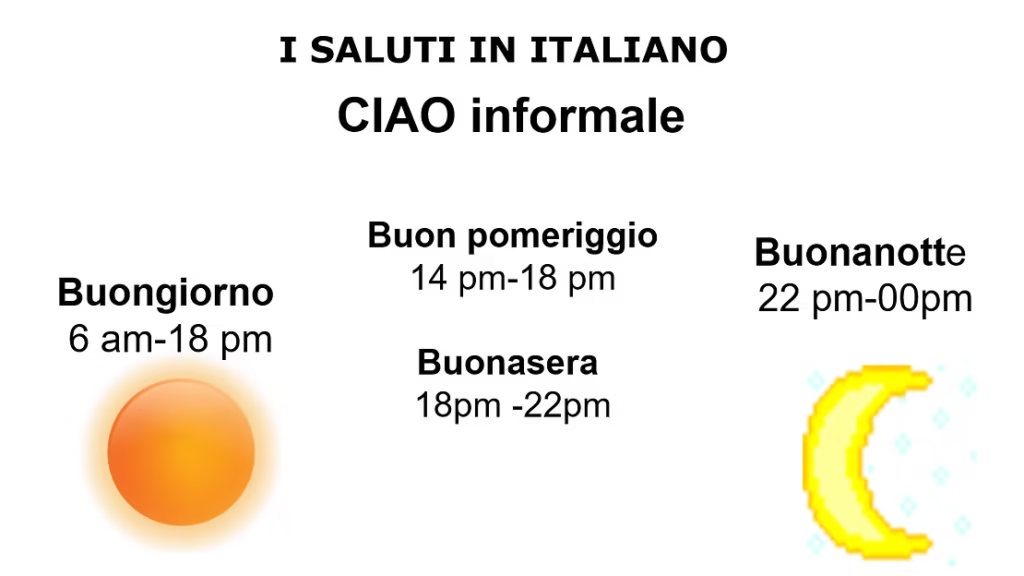
Greeting habits vary too. Even the word ciao has regional origins: it derives from a Venetian expression meaning “I am your slave” (s-ciào vostro), a polite greeting that spread across Italy. The moment when people switch from buongiorno to buonasera also differs from speaker to speaker and from area to area, so do not worry if you hear buonasera earlier or later than your coursebook suggests.
5. Swiss Italian
If you live or work in Ticino or in the Italian-speaking valleys of Graubünden, you will also meet Swiss Italian, which has its own vocabulary shaped by contact with German and French: for instance, the mobile phone is often called il natel, and the Swiss postal bus is l’autopostale. It is standard Italian in grammar, with Swiss touches in words and pronunciation. I know this first-hand: my husband is Italian, and he often teases me about the Ticino words I use.
A short dialogue: one fruit, one pastry, two names
Anna is from Milan and Luca is from Rome. They meet at a market stall on a hot summer morning. Read the dialogue aloud and notice how they handle the difference.
Anna: Ti va un po’ di anguria? È freschissima.
Luca: L’anguria? Ah, il cocomero! A Roma lo chiamiamo così.
Anna: Ma allora è lo stesso frutto?
Luca: Sì, un frutto e due nomi. Dopo prendiamo un cornetto al bar?
Anna: Volentieri! Io di solito dico brioche, ma è la stessa cosa.
In English: “Do you fancy some watermelon? It’s very fresh.” / “Watermelon? Ah, cocomero! That’s what we call it in Rome.” / “So it’s the same fruit?” / “Yes, one fruit and two names. Shall we have a cornetto at the café afterwards?” / “Gladly! I usually say brioche, but it’s the same thing.”
Notice the useful reflex: when a word surprises Luca or Anna, they simply ask or rephrase (è la stessa cosa?). You can do exactly the same, and it is much more effective than pretending to understand.
Five common mistakes learners make with regional Italian
- Treating a local word as “the” Italian word. If you learn cocomero in Rome and use it in Milan, people will understand you, but they may smile. In formal writing, prefer the most widely understood form.
- Blaming yourself when you do not understand. Speed, rhythm and local sounds change from place to place. Not understanding a Neapolitan or Sicilian speaker straight away does not mean your Italian is poor.
- Copying dialect expressions too early. A word like mo’ is natural in a Roman friendship, but it sounds odd in an email to a landlord or a university office.
- Ranking regions. No region speaks “the real Italian”. Standard Italian and regional Italian are two layers of the same language, and a good listener learns to move between them.
- Training the ear on one kind of audio only. If you only listen to news presenters, the street will surprise you. If you only watch regional comedies, formal situations will.
Exercise: regional Italian in practice
Answer the questions, then check the solutions below.
- A friend from Rome offers you a slice of cocomero. What are you about to eat?
- In Milan, a colleague asks if you want a michetta with some cheese. What is it?
- A Roman friend says Mo’ arrivo! What does he mean?
- In Ticino someone asks for your natel number. What do they want?
- True or false: dialects are just “bad Italian”.
- Write a polite question to find out whether a word you heard is Italian or dialect.
Solutions: 1. watermelon. 2. a bread roll. 3. “I’m coming right now” (mo’ means “now”). 4. your mobile phone number. 5. False: dialects developed from Latin alongside Tuscan and are languages in their own right with their own history. 6. For example: Scusa, cosa vuol dire questa parola? È italiano o dialetto?
Questions to reflect on
- Which Italian region do you hear most often (in films, music, among colleagues)? How is it different from the Italian in your coursebook?
- In which situations is it better to use neutral standard Italian, and in which can you allow yourself a regional word?
- Think about your own language: does it have regional words or accents? How do you help a foreigner understand them?
An idea to practise: choose one region per month and collect ten words, three expressions and one short audio clip from it. After a year you will have a personal map of Italy’s linguistic variety. If you live in Switzerland, start from home: see also common mistakes of Swiss-German speakers in Italian and the village food festivals in Italian sagre, where you will hear plenty of local words.
Why starting with standard Italian still matters
Despite these differences, learning standard Italian first remains the right choice. It is the shared ground that allows you to be understood everywhere, it is the language of coursebooks and formal writing, and it is required in professional and administrative situations. Regional varieties are acquired naturally by living in or travelling around Italy, like a second layer of understanding that grows with experience. The best approach is to build a solid base and then deliberately widen your ear.
How to train your ear for real Italian
- Listen to different voices: films, series and podcasts from different regions (a Milanese, a Roman and a Sicilian speaker will give you three different experiences).
- Use subtitles in Italian, not in your own language, to connect sounds and spelling.
- Ask people to repeat or rephrase: Scusa, puoi ripetere più lentamente? or Cosa vuol dire questa parola? È italiano o dialetto? Italians are usually delighted to explain.
- Keep a notebook of regional words you meet, with the place where you heard them.
- Talk to people from different cities, online or in person, and compare how they name everyday things.
Mini quiz: where would you hear it?
- Which word for “watermelon” is typical of Rome and central Italy: anguria or cocomero?
- In which area is the pastry usually called brioche rather than cornetto?
- What do we call the “Italian of everyday use coloured by local features”?
Answers: 1. cocomero – 2. Milan and the north – 3. italiano regionale.
Prepare for the exam and for real Italy
In my lessons, alongside preparation for the exam with standard Italian, I also give you a realistic idea of what you will find when you live in Italy or Switzerland, with its regional authenticity. Discover how I work at my-italian-teacher.ch, book a free 30-minute trial lesson or join the waiting list for my structured courses.
Read also: food as cultural identity in Italy. Not sure about your level? Take the free Italian level test.
Sources
- ISTAT – L’uso della lingua italiana, dei dialetti e delle lingue straniere (2024)
- Dipartimento per gli Affari regionali – Tutela delle minoranze linguistiche storiche (Legge 482/1999)
- Italiano regionale – Enciclopedia dell’Italiano, Treccani
- Gorgia toscana – Enciclopedia dell’Italiano, Treccani
- Raddoppiamento sintattico – Enciclopedia dell’Italiano, Treccani
- Ciao – Vocabolario Treccani
📚 The page before the street
To understand regional Italian you first need a solid base in standard Italian, and reading is the calmest way to build it. Graded readers are written for your level. I recommend:
- Short Stories in Italian for Beginners (Olly Richards, Teach Yourself) – short stories written for beginners, to build a reading habit in Italian.
- Short Stories in Italian for Intermediate Learners (Olly Richards, Teach Yourself) – the next step, with stories for intermediate learners.
- Storie per principianti dalla A alla Z (Valeria Blasi, Alma Edizioni) – graded readers for the first levels, entirely in Italian.
Affiliate links · As an Amazon Associate I earn from qualifying purchases.
💡 Want to learn Italian with a complete path?
I am preparing a series of Italian courses from A1 to C2, with clear lessons, exercises and a step-by-step method. 👉 Join the waiting list and you will be among the first to know when they open.