Ciao or buongiorno? Arrivederci or salve? It’s often the very first choice you make in Italian, before you’ve said anything else, and it gets much easier once you know who you’re talking to. Here is how I explain it to beginners (A1).
By Rossana Pazzaglia, native Italian teacher with a CEDILS certification in teaching Italian to foreigners (Ca’ Foscari University of Venice) · Updated 19 October 2026
In two minutes
- Ciao: hello and goodbye, only with people you call tu.
- Buongiorno / Buonasera: always safe, with everyone; buonasera from the late afternoon.
- Arrivederci: the polite goodbye for almost every situation.
- Salve: a neutral hello, but experts disagree on how formal it is.
- Buonanotte: only when you leave late at night or go to bed.
The basics: “Ciao” and “Salve”
The most common Italian greeting you’ll hear and use is “Ciao!” The same little word works for both “hello” and “goodbye” and is typically used in informal settings with friends, family, or people you know well. Think of it like “hi” or “bye” in English.
For a slightly more formal or neutral greeting, especially when you’re not sure if “Ciao” is appropriate, you can use “Salve”. This is a safe bet in many situations, like when addressing shopkeepers, service staff, or people you’ve just met. Be aware, though, that Italian experts do not fully agree on how formal salve really is: I explain the debate below.
Greetings throughout the day
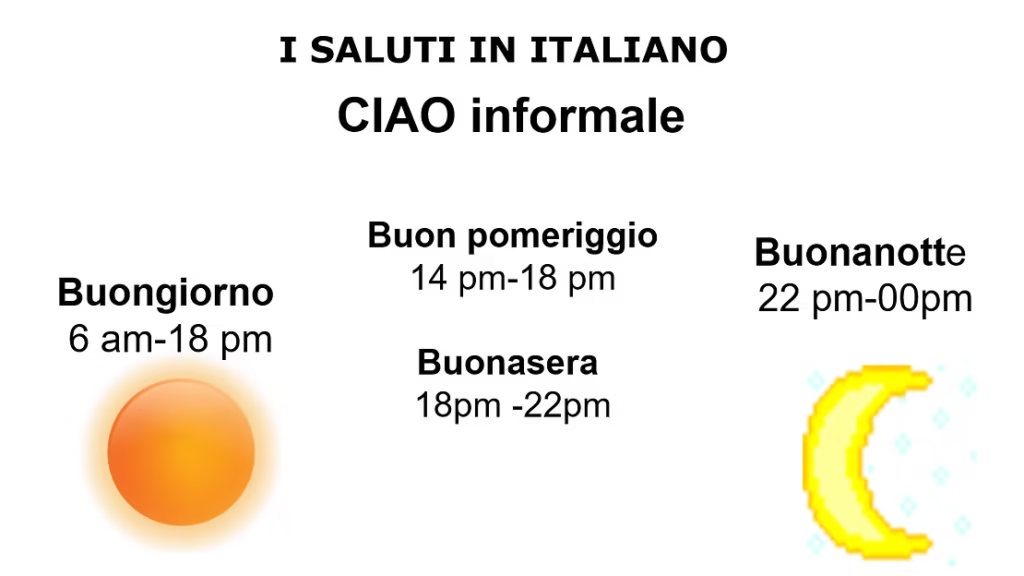
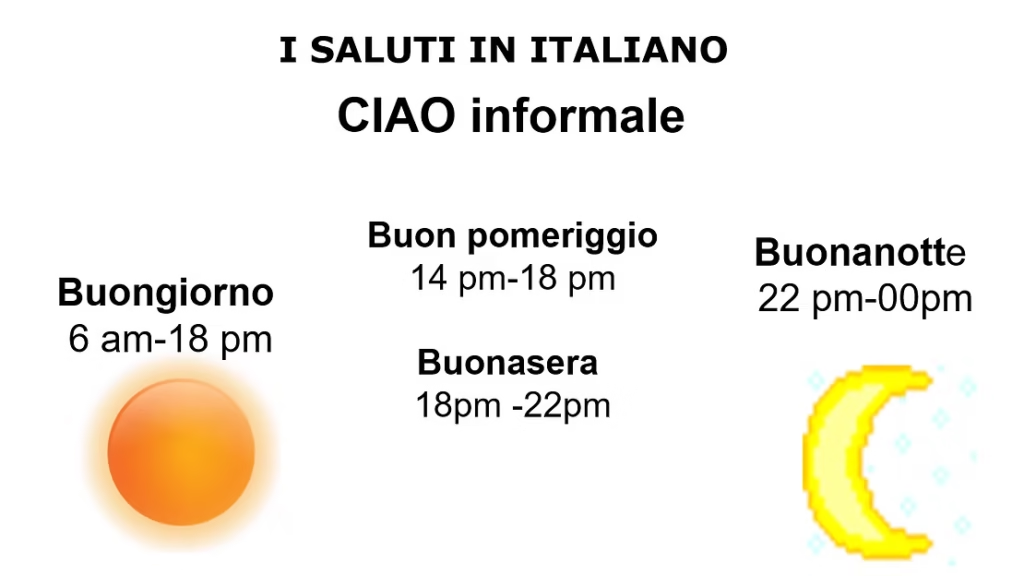
Just like in English, Italians have specific greetings for different times of the day:
Buongiorno! This means “Good morning” and can be used throughout the morning and into the early afternoon. It’s appropriate in both formal and informal contexts.
Buon pomeriggio! While less common in everyday conversation than Buongiorno or Buonasera, this means “Good afternoon.” You might hear it, but Buongiorno often extends into the early afternoon, and Buonasera typically starts earlier than “good evening” in English.
Buonasera! Meaning “Good evening,” you’ll start using this as the afternoon progresses, usually from around 4 or 5 pm onwards. Like Buongiorno, it’s suitable for both formal and informal situations.
Buonanotte! This translates to “Good night.” It is used when you’re leaving someone late in the evening or going to bed, not as a greeting when you arrive somewhere at night.
Saying goodbye
- Ciao! Informal, with friends and family.
- Arrivederci! “Goodbye”: polite and neutral, you can use it almost everywhere.
- ArrivederLa! Very formal, when you use Lei with someone (a client, an older person you don’t know).
- A presto! “See you soon.”
- Ci vediamo! “See you!”, informal.
- Buona giornata! / Buona serata! “Have a nice day / evening!”, when you leave a shop or say goodbye to someone.
Tu or Lei?
Italian has an informal “you” (tu) and a formal “you” (Lei). With friends, family and young people you use tu and ciao. With people you don’t know, in shops, offices and at work you use Lei and buongiorno, buonasera or arrivederci.
When in doubt
If you’re unsure which greeting to use, especially when meeting someone new or entering a shop, “Buongiorno” (in the morning and early afternoon) or “Buonasera” (in the late afternoon and evening) are always safe and polite choices. When you leave, say “Arrivederci”.
Where these words come from
Knowing the origin of a word helps you remember it, so here are two short stories.
Ciao comes from the Venetian dialect. According to the Treccani dictionary, it derives from s-ciao or s-ciavo, literally “(I am your) slave”, an old courtesy formula. Over time it lost this meaning and became a friendly hello and goodbye. It was once typical of northern Italy, and today it is understood all over the world. The same dictionary adds a useful detail: at the end of a letter, ciao sounds very informal.
Salve is much older. The Accademia della Crusca explains that it is inherited from Latin, where salve is the imperative of salvere, “be well”. In the Renaissance it was a greeting for meeting someone, in contrast with vale, which was used for saying goodbye.
Is “salve” formal or informal? Experts disagree
This is a good example of how a living language works. Three reliable sources describe salve in slightly different ways:
- The Accademia della Crusca notes that Italian has no neutral greeting for situations halfway between formal and informal. Salve has filled this gap, especially in emails to people whose level of formality you do not know. Some people find it a little curt, but the Accademia considers it perfectly acceptable.
- The Treccani article on salve says that many language courses call it semi-formal and that it can be used with both tu and Lei. Others find it youthful or even rude. It is a greeting for meeting people, not for leaving.
- The Treccani grammar classifies salve among the informal greetings and advises against using it outside clearly informal contexts.
So what should you do in practice? With friends, use ciao. In a shop, at work or with someone older, choose buongiorno or buonasera, because nobody will ever find them wrong. Use salve when you want a relaxed tone but do not want to sound too familiar, and remember that some Italians may react to it in different ways.
Common mistakes to avoid
- Using “buonanotte” to say hello. It is only for saying goodnight.
- Using “addio” for a normal goodbye. According to the Treccani grammar, addio signals a definitive farewell, for example a permanent departure or the end of a relationship. (In Tuscany it has traditionally been a softer goodbye, similar to arrivederci.) For everyday goodbyes use arrivederci or a presto.
- Using “salve” to leave. The sources above agree that it belongs to the moment of meeting. For leaving, choose arrivederci or buona giornata.
- Mixing registers. Do not say ciao and then Lei in the same sentence; keep tu with ciao and Lei with buongiorno.
Two mini-dialogues
1. At the bar, ordering a coffee (formal, Lei)
- – Buongiorno! (Good morning!)
- – Buongiorno, desidera? (Good morning, what would you like?)
- – Un caffè, per favore. (A coffee, please.)
- – Ecco a Lei. (Here you are.) Grazie e buona giornata! (Thank you and have a nice day!)
- – Arrivederci! (Goodbye!)
2. Between two friends (informal, tu)
- – Ciao, Marco! Come stai? (Hi, Marco! How are you?)
- – Ciao, Giulia! Bene, e tu? (Hi, Giulia! Fine, and you?)
- – Anch’io, grazie. Ci vediamo domani? (Me too, thanks. See you tomorrow?)
- – Sì, a domani! Ciao! (Yes, until tomorrow! Bye!)
Practice: choose the right greeting
What do you say in each situation? Think first, then check the answers.
- You enter a pharmacy at 10 a.m.
- You meet your best friend in the street.
- You leave a restaurant at 9 p.m. and say goodbye to the waiter.
- You say goodbye to a client you do not know well.
- You are going to bed and say goodnight to your host family.
Answers: 1. Buongiorno! 2. Ciao! 3. Arrivederci! or Buona serata! 4. Arrivederci! (or ArrivederLa! if you want to be very formal). 5. Buonanotte!
Sources
- Accademia della Crusca, Consulenza linguistica: Sull’uso di “salve” come formula di saluto (accessed 16 October 2026)
- Treccani, Magazine – Lingua italiana: “Salve, un saluto per tutti?” (Piera Molinelli; accessed 16 October 2026)
- Treccani, La grammatica italiana: “Saluto, formule di” (accessed 16 October 2026)
- Treccani, Vocabolario: “ciao” (accessed 16 October 2026)
Continue learning
- The Italian alphabet and pronunciation (A1)
- Gender and number of Italian nouns (A1)
- Ferragosto: the history of the Italian summer holiday
Ready to go beyond ciao? Start with the free Italian level test or book a free 30-minute trial lesson.
📚 Is it ciao or arrivederci? Check it in a dictionary
A good learner’s dictionary does more than translate: it tells you whether a word is formal or informal, which is exactly the problem with greetings. I recommend:
- Collins Easy Learning Italian Dictionary (Collins) – bilingual English–Italian dictionary designed for learners.
- Collins Italian Gem Dictionary (Collins) – a pocket-size bilingual dictionary to carry everywhere.
- Collins Italian Visual Dictionary (Collins) – vocabulary organised by theme, with illustrations.
Affiliate links · As an Amazon Associate I earn from qualifying purchases.
💡 Want to learn Italian with a complete path?
I am preparing a series of Italian courses from A1 to C2, with clear lessons, exercises and a step-by-step method. 👉 Join the waiting list and you will be among the first to know when they open.