🇮🇹 Leggi questo articolo in italiano
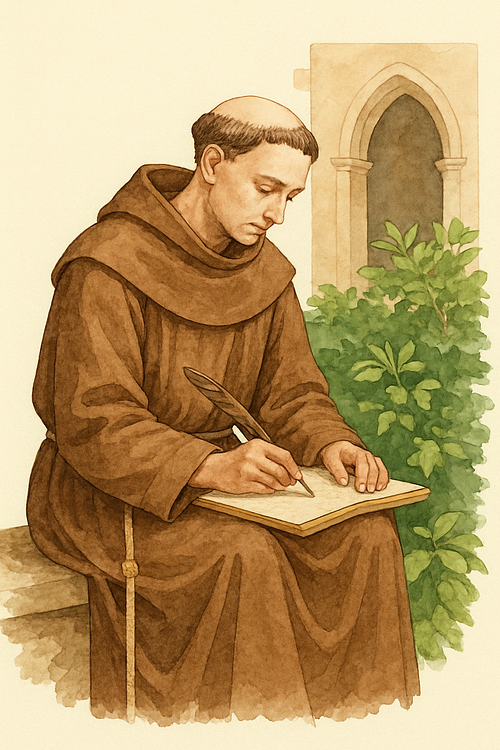
When people talk about the origins of the Italian language, the first name that comes to mind is almost always Dante. But almost a century before the Divine Comedy, a friar from Assisi had already written one of the most important texts in Italian literature: the Canticle of the Creatures (Cantico delle Creature) by Saint Francis of Assisi.
Who was Francis
Francis was born in Assisi, in Umbria, in 1181 or 1182. He was the son of Pietro di Bernardone, a wealthy cloth merchant, and as a young man he dreamed of glory as a knight. Then everything changed: he gave up his family’s wealth, chose a life of absolute poverty and began to preach. Around him grew the order of the Friars Minor, the Franciscans, which quickly spread across Europe.
He died in 1226 and was declared a saint only two years later. Since 1939 he has been the patron saint of Italy, together with Saint Catherine of Siena, and his feast day is 4 October.
The Canticle of the Creatures
The Canticle of Brother Sun, or Canticle of the Creatures, is a prayer-poem written around 1224-1226, in the last years of Francis’s life, when he was ill and almost blind. In each stanza Francis praises God through His creatures: the sun, the moon and the stars, the wind, water, fire, the earth and even death, which he calls “sister”.
Why it matters so much for Italian
In the 13th century almost everything written in Italy was in Latin, the language of the Church and of learning. Ordinary people spoke the vernacular (volgare): the local languages that had developed from spoken Latin.
Older written examples of the vernacular exist, such as the Placiti cassinesi of 960, but they are short formulas or practical documents. The Canticle is considered the first great poetic text of Italian literature by a known author. Choosing the vernacular to speak about God was a strong gesture: it meant speaking to everyone, including people who had never studied.
A taste of the text
Altissimu, onnipotente, bon Signore,
tue so’ le laude, la gloria e l’honore et onne benedictione.
(Most High, all-powerful, good Lord, yours are the praises, the glory, the honour and all blessing.)
Laudato si’, mi’ Signore, per sora luna e le stelle:
in celu l’ài formate clarite et pretiose et belle.
(Praised be You, my Lord, for Sister Moon and the stars: in heaven You formed them, clear, precious and beautiful.)
The 13th-century Umbrian vernacular is different from modern Italian, but many words are still recognisable: onnipotente, gloria, luna, stelle, belle. The words “Laudato si'” even became the title of Pope Francis’s 2015 encyclical on the environment.
Why these origins help you learn Italian
I won’t ask you to read the Canticle in a beginner’s lesson! But knowing where the language you are studying comes from helps you understand many of its features. Today’s Italian is the result of a long journey: from Francis’s Umbrian vernacular to the Florentine of Dante, Petrarch and Boccaccio, and finally to the common language spoken today.
Continue the journey
- Listen to the podcast on Dante Alighieri, life and works.
- Discover Giovanni Boccaccio and the Decameron.
Do you love the link between language, literature and culture? I am preparing an Italian literature masterclass; in the meantime we can read the great authors together in my private online lessons.
📚 Further reading
To read the texts of Saint Francis:
- I fioretti di San Francesco (ed. integrale) (Crescere) – the stories about the life of Saint Francis, in the complete edition.
Affiliate links · As an Amazon Associate I earn from qualifying purchases.
🎧 Do you love Italian art and literature?
I am preparing a series of Italian courses from A1 to C2, plus two masterclasses on Italian literature and art history. 👉 Join the waiting list and you will be among the first to know when they open.

