🇮🇹 Leggi questo articolo in italiano
By Rossana Pazzaglia, native Italian teacher with a CEDILS certification in teaching Italian to foreigners (Ca’ Foscari University of Venice) · Updated 19 October 2026
“Se avessi studiato di più…” (If I had studied more…). “Pensavo che fossero già partiti.” (I thought they had already left.) If you have ever heard or said sentences like these, you have met the congiuntivo trapassato, the past perfect subjunctive. It is one of the tenses that separate an intermediate learner from an advanced one, and it is much less scary than it looks. The subjunctive is one of the topics my students find hardest, so no rush: we’ll take it apart and put it back together.
What the past perfect subjunctive is
The congiuntivo trapassato is the subjunctive tense used to express an action that happened before another past action or situation, when the sentence requires the subjunctive: after verbs of opinion, doubt, hope or wish, after certain conjunctions, and in hypothetical sentences. It corresponds to the English “had + past participle” in many contexts, but it is only used where Italian requires the subjunctive mood.
How to form it
The formula is simple:
imperfect subjunctive of avere or essere + past participle
| with avere (mangiare) | with essere (partire) | |
|---|---|---|
| che io | avessi mangiato | fossi partito/a |
| che tu | avessi mangiato | fossi partito/a |
| che lui/lei/Lei | avesse mangiato | fosse partito/a |
| che noi | avessimo mangiato | fossimo partiti/e |
| che voi | aveste mangiato | foste partiti/e |
| che loro | avessero mangiato | fossero partiti/e |
The choice between avere and essere follows the same rules as the passato prossimo: transitive verbs and most others take avere; verbs of movement or change of state (andare, venire, partire, arrivare, nascere, diventare), reflexive verbs and the verb essere itself take essere. With essere, the past participle agrees in gender and number with the subject: Pensavo che Maria fosse già arrivata. Reflexive verbs also take essere: Credevo che si fossero alzati presto.
Tip: if you know the imperfect subjunctive (avessi, avessi, avesse…; fossi, fossi, fosse…), you already know 80% of the trapassato. The only new element is the participle.
When to use it
1. After a main verb in the past, to express a previous action
When the main verb is in a past tense (imperfect, passato prossimo, trapassato, conditional) and requires the subjunctive, the action that happened before goes in the trapassato:
- Pensavo che avessero già finito. (I thought they had already finished.)
- Non credevo che tu fossi stato così sincero. (I did not think you had been so honest.)
- Mi sembrava che Luca avesse capito. (It seemed to me that Luca had understood.)
2. In the third conditional (impossible past hypotheses)
The if clause takes the trapassato; the result clause usually takes the condizionale composto:
- Se avessi saputo, ti avrei chiamato. (If I had known, I would have called you.)
- Se fossimo partiti prima, non avremmo perso il treno. (If we had left earlier, we would not have missed the train.)
Mixed hypotheses are common too, where the past condition has a present result: Se avessi studiato di più, ora parlerei meglio. (If I had studied more, I would speak better now.)
3. After “come se” (as if)
- Parlava come se avesse vissuto in Italia per anni. (He spoke as if he had lived in Italy for years.)
4. To express wishes and regrets about the past
- Magari avessi accettato quel lavoro! (If only I had accepted that job!)
- Se solo avessi ascoltato i tuoi consigli! (If only I had listened to your advice!)
- Avrei voluto che tu fossi venuto alla festa. (I would have liked you to come to the party.)
5. After concessive conjunctions, when the action is previous
- Sebbene avesse studiato molto, non superò l’esame. (Although he had studied a lot, he did not pass the exam.)
Past subjunctive or past perfect subjunctive?
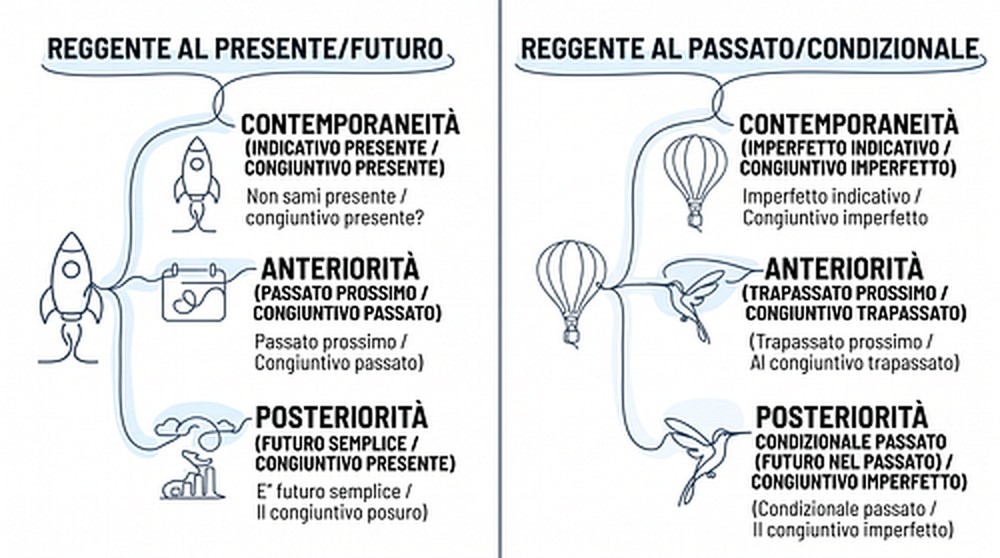
Many learners confuse the congiuntivo passato (che io abbia mangiato) with the congiuntivo trapassato (che io avessi mangiato). The rule is about the tense of the main verb:
| Main verb | Previous action | Example |
|---|---|---|
| Present (penso) | congiuntivo passato | Penso che abbiano finito. |
| Past (pensavo) | congiuntivo trapassato | Pensavo che avessero finito. |
In other words: present in the main clause, passato; past in the main clause, trapassato.
Five common mistakes
- Using the indicative instead of the subjunctive: “Pensavo che avevano finito” is not correct in standard Italian. Say Pensavo che avessero finito.
- Using the conditional in the if clause: “Se avrei saputo…” is wrong. After se in a hypothesis you need the subjunctive: Se avessi saputo…
- Forgetting the participle agreement with essere: Credevo che fossero arrivato should be fossero arrivati.
- Mixing up the tenses of the main and subordinate clause: check whether the main verb is present or past before choosing passato or trapassato.
- Choosing the wrong auxiliary: when in doubt, ask yourself which auxiliary you would use in the passato prossimo.
The impossible “if” sentence: two clarifications
Present or past conditional in the main clause?
In the third type of hypothetical sentence the if clause stays in the congiuntivo trapassato, but the main clause can take the past conditional or, when the consequence still holds today, the present conditional. Compare: Se avesse letto il libro, gli sarebbe piaciuto (both condition and consequence belong to the past) and Se avesse letto il libro, capirebbe il film (the consequence is true now). One rule is easy to remember: a conditional never follows se in a hypothesis, and the order of the two clauses can be reversed without changing the meaning: Ti avrei chiamato, se avessi saputo. The Treccani grammar and the open textbook of the University of Iowa, both listed in the Sources, describe the same pattern.
Why you hear the imperfect in spoken Italian
A University of Bologna thesis on the hypothetical imperfect recalls that constructions such as Se partivi prima, prendevi il treno were long considered substandard and that, according to the linguist Nencioni (1987), they spread above all in speech. Today they belong to what linguists call neo-standard Italian, but the difference in register remains. Among friends the imperfect is natural and perfectly understood; in an essay, a formal letter or an exam it is safer to use the congiuntivo trapassato and the past conditional. Knowing both forms lets you choose the right one for the situation.
Questions to reflect on
- What changes between Penso che sia partito and Pensavo che fosse partito?
- In which situations would you use the hypothetical imperfect, and in which the trapassato?
- Can you find, in a song or a film, a sentence with se + congiuntivo trapassato?
Practice: exercises with answers
Exercise 1: complete with the congiuntivo trapassato
- Pensavo che tu ______ (finire) il lavoro.
- Se ______ (io, sapere) la verità, non avrei detto quelle cose.
- Parlava come se ______ (lui, vedere) un fantasma.
- Credevo che loro ______ (partire) già.
- Magari ______ (noi, restare) più a lungo!
Answers: 1. avessi finito – 2. avessi saputo – 3. avesse visto – 4. fossero partiti – 5. fossimo restati (the verb rimanere would give fossimo rimasti).
Exercise 2: past or past perfect subjunctive?
- Penso che Marta (essere) ______ già qui.
- Pensavo che Marta (essere) ______ già qui.
Answers: 1. sia stata (main verb in the present) – 2. fosse stata (main verb in the past).
Exercise 3: your turn
Write three sentences about something you regret or wish had gone differently, using Se avessi… and Magari…. Share them with your teacher for feedback.
Exercise 4: from reality to hypothesis
Turn the sentences into third-type hypothetical sentences (the last one is a mixed type).
- Non ho studiato, quindi non ho superato l’esame.
- Siete usciti tardi e avete perso l’autobus.
- Luca non mi ha avvisata, perciò sono rimasta a casa.
- Non ho studiato medicina, e ora non faccio il medico.
Answers: 1. Se avessi studiato, avrei superato l’esame. – 2. Se foste usciti prima, non avreste perso l’autobus. – 3. Se Luca mi avesse avvisata, non sarei rimasta a casa. – 4. Se avessi studiato medicina, ora farei il medico.
If you want to revise the auxiliaries and participles first, the free A1 grammar course on the blog is a good place to start.
Practise with me
The subjunctive scares almost everyone, but with concrete examples and a bit of consistency it can be tamed. If you’d like to work on it together, my lessons start from what you actually need. Discover how I work at my-italian-teacher.ch, book a free 30-minute trial lesson or join the waiting list for my structured courses.
Read also: the Italian sequence of tenses. Not sure about your level? Take the free Italian level test.
Sources
- Treccani – Congiuntivo trapassato (La grammatica italiana)
- Treccani – Periodo ipotetico (La grammatica italiana)
- University of Iowa, D’accordo (open textbook) – Periodo ipotetico
- University of Bologna (AMS Laurea) – thesis on the hypothetical imperfect indicative in Italian
📚 Train the subjunctive every day
The subjunctive only sticks with plenty of practice: short sentences, checked straight away. To practise on your own, with an answer key, I recommend:
- Italian Grammar in Practice (Susanna Nocchi, Alma Edizioni) – rules explained in English, with exercises, tests and games.
- Practice Makes Perfect: Complete Italian All-in-One (Marcel Danesi, McGraw Hill) – grammar and vocabulary in one workbook, with plenty of exercises.
Affiliate links · As an Amazon Associate I earn from qualifying purchases.
🎁 Free download: Guide to the Italian Subjunctive
Tense table, examples and a mini-test with answers, as a PDF. Leave your email: we send you a confirmation message, then you can download the guide (and the prepositions cheat sheet) from the Free resources page. The form and the emails are in Italian.
💡 Want to learn Italian with a complete path?
I am preparing a series of Italian courses from A1 to C2, with clear lessons, exercises and a step-by-step method. 👉 Join the waiting list and you will be among the first to know when they open.