🇮🇹 Leggi questo articolo in italiano
By Rossana Pazzaglia, native Italian teacher with a CEDILS certification in teaching Italian to foreigners (Ca’ Foscari University of Venice) · Updated 19 October 2026
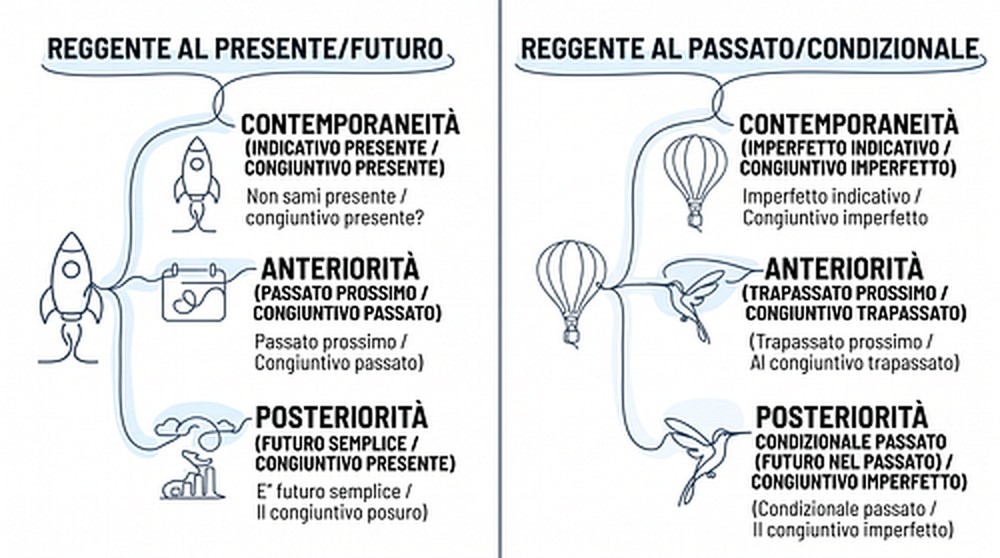
“Pensavo che tu hai ragione.” How often have you heard (or said) a sentence like this, with the feeling that something was off? The issue is the sequence of tenses (concordanza dei tempi): choosing the right tense in the subordinate clause in relation to the verb of the main clause. The subjunctive is one of the topics my students find hardest, and the sequence of tenses makes it look even more daunting. But it follows a clear logic and, once you see it, it becomes almost automatic. I like to explain it with a simple picture, two “families” of tenses: you’ll find it further down, along with the most frequent mistakes and a few exercises.
What the Sequence of Tenses Is
According to Treccani’s Enciclopedia dell’italiano, the sequence of tenses is the relationship between the tense of the main-clause verb and that of the subordinate-clause verb [1]. That relationship expresses three temporal relations:
- simultaneity (contemporaneità): both actions happen at the same time;
- anteriority: the subordinate action happened earlier;
- posteriority: the subordinate action happens later.
The same source points out that Italian is more flexible than the rigid Latin consecutio temporum, so everyday language admits some exceptions [1].
With the Indicative: Intuitive Logic
With the indicative the choice depends on meaning. If the main clause is in the present, the subordinate can be present, past or future:
- Dico che vengo. (I say I’m coming – simultaneity)
- Dico che sono venuto. (I say I came – anteriority)
- Dico che verrò. (I say I will come – posteriority)
If the main clause is in the past, the subordinate “slides” back:
- Ho detto che venivo. (simultaneity: imperfect)
- Ho detto che ero venuto prima. (anteriority: trapassato prossimo)
- Ho detto che sarei venuto. (posteriority: past conditional)
With the Subjunctive: The Rule in a Table
With the subjunctive the choice is stricter. Treccani’s indications can be summarised like this [1]:
| Relation | Main clause in the present (or future) | Main clause in the past |
|---|---|---|
| Simultaneity | present subjunctive Penso che tu abbia ragione. | imperfect subjunctive Pensavo che tu avessi ragione. |
| Anteriority | past subjunctive Penso che tu abbia già mangiato. | past perfect subjunctive Pensavo che tu avessi già mangiato. |
| Posteriority | simple future Penso che verrai. | past conditional Pensavo che saresti venuto. |
Note: for posteriority the subjunctive is not used; you use the indicative future or the past conditional. The present subjunctive is nevertheless possible in some cases with a future meaning: Spero che domani faccia bel tempo. (I hope the weather will be nice tomorrow.)
A Mental Shortcut
Imagine two “families” of tenses. If the main verb is in the present (penso, credo, spero), you use the present family: present and past subjunctive. If it is in the past (pensavo, ho pensato, pensai), you “step down” one level and use the past family: imperfect and past perfect subjunctive.
The Most Common Mistakes
1. Present subjunctive after a past tense
❌ Pensavo che Marco sia a scuola.
✅ Pensavo che Marco fosse a scuola.
2. Indicative instead of subjunctive
❌ Credevo che lui era stanco. (frequent in informal speech)
✅ Credevo che lui fosse stanco. (more correct, especially in writing)
3. Forgetting the past perfect for a prior action
❌ Non sapevo che tu sei già partito.
✅ Non sapevo che tu fossi già partito.
Mini-Dialogue
Giulia: Pensavo che Paolo fosse ancora in vacanza.
Sara: No, credo che sia tornato ieri sera.
Giulia: Ah! Non immaginavo che avesse già finito le ferie. Pensavo che sarebbe rimasto fino a domenica.
Exercises
Complete with the right tense.
- Penso che Anna ___ (essere) in ufficio adesso.
- Pensavo che Anna ___ (essere) in ufficio.
- Credo che Luca ___ (partire) ieri.
- Credevo che Luca ___ (partire) il giorno prima.
- Mi hanno detto che ___ (venire, loro) domani.
Answers: 1) sia; 2) fosse; 3) sia partito; 4) fosse partito; 5) verranno (or, with a past verb: “Mi avevano detto che sarebbero venuti domani”).
Who Decides the Mood? The Governing Verb
Many learners ask why one verb takes the subjunctive and another the indicative. According to Treccani, in object and subject clauses the mood is not a free choice of the speaker: it is imposed by the governing verb [2]. So penso che, credo che and spero che call for the subjunctive, while so che and dico che call for the indicative. The same page notes that using the indicative where the subjunctive is expected does not change the meaning of the sentence; it only lowers the register [2]. In practice, Credevo che era tardi will be understood perfectly in a chat, but in an exam essay or a formal email you should write Credevo che fosse tardi.
If-Sentences: Three Patterns to Keep Apart
A teaching page from the University of Vermont distinguishes three kinds of hypothetical sentence [3]. Here they are with my own examples:
- Real or possible: se + indicative. Se piove, resto a casa. (If it rains, I stay home.)
- Unlikely or imagined: se + imperfect subjunctive + present conditional. Se abitassi a Roma, andrei spesso ai musei. (If I lived in Rome, I would often go to museums.)
- Impossible, because it concerns the past: se + past perfect subjunctive + conditional. Se avessi studiato di più, avrei superato l’esame. (If I had studied more, I would have passed the exam.)
Only the second and third patterns use the subjunctive, and in both the subjunctive sits in the se-clause, never in the clause with the conditional.
Two Tricky Cases Worth Knowing
A past main verb, but a situation that is still true
The table gives the standard rule, but in my lessons I often meet sentences such as Non ho mai pensato che sia facile (I have never thought it is easy). Here the main verb is a present perfect, yet the opinion still holds today, so the present subjunctive feels natural. Ask yourself: is the situation over, or does it still concern the present? If it is over, step down to the past family (Non pensavo che fosse facile).
The conditional in the main clause
After a main verb in the present conditional, the subordinate takes the imperfect subjunctive: Vorrei che tu venissi con noi. (I would like you to come with us.) Learners often write Vorrei che tu vieni, mixing the two “families”.
More Practice
Put the verb in brackets in the right form.
- Sono sicuro che domani non ___ (piovere): il cielo è sereno.
- Non sapevo che voi ___ (trasferirsi) a Milano due anni prima.
- Se ___ (avere, io) più tempo, leggerei di più.
- Se ___ (partire, noi) prima, avremmo trovato posto.
- Vorrei che mia sorella ___ (essere) qui con noi.
Answers: 1) pioverà (after sono sicuro the indicative is used, and the action is posterior); 2) vi foste trasferiti; 3) avessi; 4) fossimo partiti; 5) fosse.
Think about it: take three sentences you said today in your own language that report a thought (“I thought that…”). Translate them into Italian and decide whether each describes simultaneity, anteriority or posteriority.
A note for Swiss-German speakers. If you live in German-speaking Switzerland and learn Italian, you will find other typical difficulties, with exercises, in common mistakes Swiss-German speakers make in Italian.
Conclusion
The sequence of tenses becomes natural with practice: read, listen and try turning sentences from the present into the past. And if you’d rather practise with me, calmly and without worrying about mistakes, book a free 30-minute trial lesson, join the course waiting list or take the free level test. To go deeper, read also the Italian past perfect subjunctive.
Sources
- [1] Riccardo Cimaglia, “Concordanza dei tempi”, Enciclopedia dell’Italiano, Treccani (accessed 6 October 2026)
- [2] “Congiuntivo”, Enciclopedia dell’Italiano, Treccani (accessed 6 October 2026)
- [3] “Hypothetical constructions (periodo ipotetico)”, Italian grammar pages, University of Vermont (accessed 6 October 2026)
The wrong examples reflect the typical mistakes of learners reaching B2.
📚 Practice makes it automatic
The sequence of tenses only becomes automatic with practice: many short exercises, checked straight away. For that, I recommend:
- Italian Grammar in Practice (Susanna Nocchi, Alma Edizioni) – rules explained in English, with exercises, tests and games.
- Practice Makes Perfect: Complete Italian All-in-One (Marcel Danesi, McGraw Hill) – grammar and vocabulary in one workbook, with plenty of exercises.
Affiliate links · As an Amazon Associate I earn from qualifying purchases.
💡 Want to learn Italian with a complete path?
I am preparing a series of Italian courses from A1 to C2, with clear lessons, exercises and a step-by-step method. 👉 Join the waiting list and you will be among the first to know when they open.