🇮🇹 Leggi questo articolo in italiano
“Devo studiare.” “Posso entrare?” “Voglio un caffè.” “So nuotare.” These four small verbs appear in almost every conversation: you use them to ask permission, say what you have to do, express a wish or describe an ability. Their grammar is simple in the present tense, but two points often surprise learners: where to put the pronouns (lo devo fare or devo farlo?) and which auxiliary to use in the passato prossimo (ho dovuto partire or sono dovuto partire?). Let us take them step by step, with examples that can come from the vegetable patch and the garden too: devo annaffiare i pomodori, posso raccogliere l’insalata, voglio piantare dei fiori, so potare le rose. The grammar comes from the Treccani sources listed at the end; examples, exercises and advice are mine.
Which verbs are modal and what they express
In Italian grammar the modal verbs (also called verbi servili) are verbs that combine with an infinitive to say how an action happens. The Treccani grammar lists three basic meanings: possibility (potere: Finalmente posso sedermi a tavola), will (volere: Vuole andare a Roma) and necessity (dovere: Dobbiamo stare più attenti). The Enciclopedia dell’italiano is stricter and considers only dovere, potere and volere as true modals. It treats sapere as partly modal: it behaves like a modal when it means “to be able to” (so nuotare), but not when it means “to know” (so di aver sbagliato). Verbs such as solere, preferire, osare, desiderare are sometimes listed among the modals in school grammars, but the encyclopedia leaves them out.
Conjugation in the present
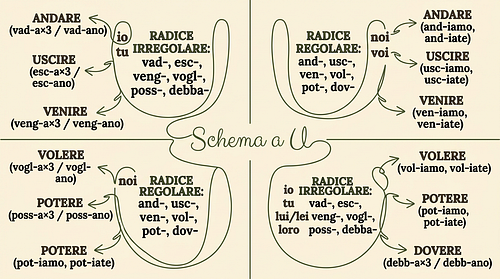
| dovere | potere | volere | sapere | |
|---|---|---|---|---|
| io | devo | posso | voglio | so |
| tu | devi | puoi | vuoi | sai |
| lui / lei | deve | può | vuole | sa |
| noi | dobbiamo | possiamo | vogliamo | sappiamo |
| voi | dovete | potete | volete | sapete |
| loro | devono | possono | vogliono | sanno |
All four are irregular, so they must be memorised. The table is from my teaching materials. After the modal, the second verb is always in the infinitive: devo studiare, puoi aspettare, vogliamo partire, sa cucinare.
How to use them: three small differences
- Potere expresses possibility or permission: Posso aprire la finestra? (May I?) or Non posso venire, ho un impegno (it is not possible for me).
- Sapere expresses a learned ability: So suonare il pianoforte (I have learned). Compare with Non posso suonare il pianoforte stasera (the situation does not allow it). It is a very useful contrast to fix from the start.
- Volere is direct, so for a polite request the conditional is better: Vorrei un caffè, Potrei entrare?, Dovrei andare. Use voglio when you really want to show determination.
There is one more thing: the Treccani grammar on the imperative points out that modal verbs have no imperative form. For an order or advice you therefore use other verbs (vieni, aspetta, prova). For a refresher on how to give orders, read my article on the informal imperative.
Where the pronouns go
With a modal verb followed by an infinitive, the unstressed pronouns can go in two places, and this is the reason why Italian sounds free and flexible. The Enciclopedia dell’italiano calls it the freedom of position of unstressed pronouns: the pronoun can come before the modal verb or be attached to the infinitive.
| Before the modal | Attached to the infinitive |
|---|---|
| La devo cercare. | Devo cercarla. |
| Ci posso andare. | Posso andarci. |
| Gli voglio parlare. | Voglio parlargli. |
| Glielo devo dire. | Devo dirglielo. |
The encyclopedia gives an important rule for two pronouns: they cannot be split. Glielo devo comunicare and devo comunicarglielo are correct, but lo devo comunicargli or gli devo comunicarlo are not. With two infinitives, as in devo poter fare, the pronoun has three positions: lo devo poter fare, devo poterlo fare, devo poter farlo. For reflexive verbs, the same freedom applies: mi devo alzare or devo alzarmi; see my article on Italian reflexive verbs.
The auxiliary in the passato prossimo
This is the point that creates doubts even among Italians. The general rule, as the Treccani grammar and the Enciclopedia explain, is that the modal verb takes the same auxiliary as the infinitive that follows it:
- Ho letto → Ho dovuto leggere (leggere takes avere).
- Sono venuto → Sono dovuto venire (venire takes essere).
- Sono partito → Non sono potuto partire.
In addition, a Treccani language-advice answer explains that avere is also acceptable when the infinitive is intransitive: Ho dovuto venire / uscire / partire is as acceptable as sono dovuto venire / uscire / partire. It quotes the linguist Luca Serianni for three reasons why avere is spreading: it avoids worrying about agreement with the subject (le ragazze avrebbero dovuto partire instead of sarebbero dovute partire), the modal used alone already takes avere (hanno potuto), and when a pronoun is attached to the infinitive avere is already required: non ho potuto venirci.
The pronoun gives a practical guide. Treccani explains: if the pronoun comes before the modal, the auxiliary must be the one of the infinitive (non ci sono potuto andare, not “non ci ho potuto andare”); if the pronoun is attached to the infinitive, both are acceptable (non sono potuto andarci or non ho potuto andarci). When the infinitive is essere or a passive, the modal takes avere: Hai dovuto essere bravo, Avete voluto essere segnalati.
For exams and for beginners there is a shortcut: when in doubt, use avere, which is accepted in almost every case, and then learn the rule with essere as a refinement.
Where modals trip you up
People who think in German or French start well: müssen, können, wollen and devoir, pouvoir, vouloir work like ours, with an infinitive after them. The slips come with a preposition added by mistake (devo di andare) and with the auxiliary in the past. They are perfectly normal mistakes, and they fade with a little practice.
- Devo di andare. → Devo andare. No preposition after a modal.
- Voglio che vado. → Voglio andare. Same subject: infinitive. (With different subjects you need the subjunctive.)
- Posso a venire? → Posso venire?
- Io so venire domani. → Posso venire domani. Sapere = learned ability; potere = possibility.
- Lo devo comunicargli. → Glielo devo comunicare / Devo comunicarglielo. The two pronouns go together.
- Ho doveto andare. → Ho dovuto andare. Learn the four participles as a set: dovuto, potuto, voluto, saputo.
- Non ci ho potuto andare. → Non ci sono potuto andare / Non ho potuto andarci.
A weekend to organise
Sara: Domenica vuoi venire con noi al lago?
Matteo: Vorrei, ma non posso. Devo studiare per l’esame di storia.
Sara: Peccato! Anche l’altra volta non sei potuto venire, vero?
Matteo: Esatto, ho dovuto lavorare tutto il giorno. Posso venire sabato sera?
Sara: Certo, ma devi portare il dolce. Sai cucinare la torta di mele?
Matteo: Non so cucinarla bene, ma posso comprarla in pasticceria!
Sara: Va bene. Ci devi pensare tu!
In the dialogue you find the three main modals in the present, sapere for ability, the passato prossimo (non sei potuto venire, ho dovuto lavorare), and pronoun placement (non so cucinarla, posso comprarla, ci devi pensare). To use vorrei for restaurant requests, see the post on restaurant vocabulary.
Practise the modals
Exercise 1 – Conjugate the modal
- Noi (dovere) ______ partire presto.
- Tu (potere) ______ aiutarmi?
- Loro (volere) ______ cenare fuori.
- Io non (sapere) ______ guidare.
- Lei (dovere) ______ lavorare domani.
Answers: 1. dobbiamo; 2. puoi; 3. vogliono; 4. so; 5. deve.
Exercise 2 – Place the pronoun in two ways
- (lo) Devo fare. → ______ / ______
- (ci) Possiamo andare. → ______ / ______
- (gliela) Voglio dare. → ______ / ______
Answers: 1. Lo devo fare / Devo farlo. 2. Ci possiamo andare / Possiamo andarci. 3. Gliela voglio dare / Voglio dargliela.
Exercise 3 – Passato prossimo
- Devo studiare. → ______ studiare.
- Non posso venire. → Non ______ venire (essere).
- Vogliamo mangiare la pizza. → ______ mangiare la pizza.
- Non posso andarci. → Non ______ andarci (avere).
Answers: 1. Ho dovuto; 2. sono potuto (or ho potuto); 3. Abbiamo voluto; 4. ho potuto.
Exercise 4 – Correct the mistake
- Devo di partire adesso.
- Io posso nuotare (I learned as a child).
- Lo devo dirgli.
Answers: 1. Devo partire adesso. 2. Io so nuotare. 3. Glielo devo dire / Devo dirglielo.
A little reflection
- In your language, is there a difference between “I can swim” (ability) and “I can come on Friday” (possibility), as between so and posso?
- Write five things you must do this week, five things you can do and five things you want to do.
- Choose three sentences and put the pronoun in both possible positions.
What I would do in your place
Learn the modals as phrases rather than as isolated verbs: devo andare, posso entrare, vuoi venire?, non so cosa dire. Say them while you do things around the house. Then add the conditional (vorrei, potrei, dovrei), which makes you sound polite and natural. When the passato prossimo makes you hesitate, remember the rule “same auxiliary as the infinitive, with avere as a safe alternative”. You will review it in the next two articles of the series, which are dedicated to the passato prossimo with avere and with essere.
Let’s talk it over in class
Modals are understood by using them. If you would like to try with me, book a free trial lesson, take the level test and join the course waiting list, which is open.
Sources
- Treccani – “modali, verbi”, Enciclopedia dell’italiano
- Treccani – “Servili, verbi”, La grammatica italiana
- Treccani – Lingua italiana, Domande e risposte: l’ausiliare con potere, dovere, volere
- Treccani – “imperativo, forme di [prontuario]”, Enciclopedia dell’italiano
The list of modals, their meanings, pronoun position, choice of auxiliary and the imperative are checked on the Treccani sources above. The table, the differences between potere, sapere and volere, the dialogue, exercises and advice come from my work in the classroom.
📚 Go further
To practise this topic with clear rules and answer keys, I recommend:
- Italian Grammar in Practice (Susanna Nocchi, Alma Edizioni) – rules, exercises and tests for learners.
- Practice Makes Perfect: Complete Italian All-in-One (Danesi, McGraw-Hill) – grammar explanations and many exercises.
Affiliate links · As an Amazon Associate I earn from qualifying purchases.