🇮🇹 Leggi questo articolo in italiano
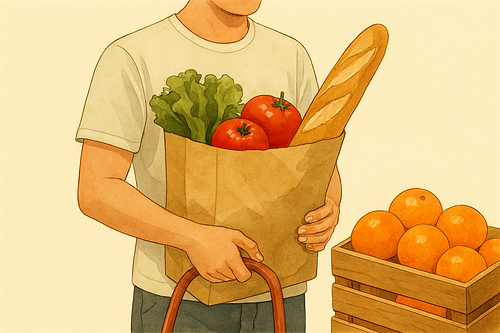
“Vorrei del pane.” “Ho comprato delle mele.” “Vuoi dell’acqua?” If you study Italian, sooner or later you meet these del, della, dei, delle that are not the preposition “di” joined to an article, but something different: the partitive article. In English it corresponds to some or any, but Italian uses it more freely and more selectively. Anyone who, like me, grows vegetables knows it: you do not pick «l’insalata», you pick dell’insalata, dei pomodori, delle zucchine. The partitive exists precisely to say «a part, an unspecified quantity». We will see when to use it, when to leave it out and which alternatives you have. The rules are checked on the sources listed at the end; examples, exercises and advice come from my lessons.
What is the partitive
According to the Enciclopedia dell’italiano, the partitive is the function that expresses taking an indefinite quantity from a set or a substance. Italian can express it in three ways: with the partitive article, with the zero article (that is, no article) and with the particle ne. Here we focus on the first.
The partitive article is formed by the preposition di joined to the definite article:
| masculine | feminine | |
|---|---|---|
| singular | del (pane), dello (zucchero), dell’ (olio) | della (pasta), dell’ (acqua) |
| plural | dei (biscotti), degli (spaghetti) | delle (mele) |
The Treccani entry specifies that the truly partitive form is the singular with mass nouns, that is, uncountable ones: prendi del burro (have some butter). The plural (dei biscotti, delle mele) is closer to a plural of the indefinite article, as if it were the plural of un biscotto, una mela.
When to use it
- Indefinite quantity of a substance (you cannot count it): Vorrei del pane. Beviamo dell’acqua. Metto dello zucchero nel caffè.
- Indefinite quantity of countable things (plural): Ho comprato delle mele. Ci sono dei biscotti in cucina.
- With abstract nouns and substantivised adjectives, in particular expressions: the source quotes ha del coraggio (he has some courage) and c’è del buono (there is something good).
- With verbs that take an indefinite object: vorremmo della verdura is correct, because “volere” allows a non-specific object. With a verb like odiare (to hate), which requires a definite object, the partitive does not work: you do not say “odio della verdura” but odio la verdura.
When not to use it: the zero article
You do not always need the partitive. The Enciclopedia dell’italiano speaks of the zero article (Ø), a noun without an article, in these cases:
- with the subject after the verb: c’è Ø latte (not “c’è del latte”);
- with the direct object after the verb: compriamo Ø giornali;
- with abstract nouns: Mario ha Ø pazienza.
The same text warns that a singular subject placed before the verb always takes the article: del caffè si è rovesciato (some coffee spilled), not “Ø caffè si è rovesciato”.
For learners, this means that in many sentences the choice between “no article” and “partitive” is a matter of nuance. These three practical rules work well at A1-A2:
- After the verb, in affirmative sentences, the partitive is always possible: Mangio del pane. Compro delle mele.
- In negative sentences it is usually preferable to leave it out: Non ho pane. Non c’è latte. Non compro mele. (The Treccani source does not cover this case: the rule comes from common usage.)
- In a question both are possible: Vuoi del tè? / Vuoi tè? – the first is politer and more common.
Alternatives to the partitive
- Un po’ di + noun (singular): Vorrei un po’ di pane. This is the most common replacement for substances, and it always sounds natural.
- Alcuni / alcune + plural: Ho comprato alcune mele. The Enciclopedia notes that the plural partitive can be replaced by alcuni/alcune.
- Qualche + singular: Ho comprato qualche mela (both verb and noun stay singular after “qualche”, even though the meaning is plural).
- The particle ne: it picks up a noun already mentioned, with a partitive value: Hai del pane? – Sì, ne ho. / Me ne dai un chilo? The Treccani entry gives exactly this example (me ne dai un chilo?) and recalls that in compound tenses the participle agrees with the quantity referred to by ne: ne ho mangiate due.
Partitive or articulated preposition?
The forms are identical, but the function is different. Compare:
- Il libro del professore → articulated preposition (di + il): it is the book of a specific person;
- Ho comprato del pane → partitive: an unspecified quantity of bread.
Treccani’s grammar, in its entry on prepositions, also reminds us that del and dello can work both as an articulated preposition and as a partitive article. To review prepositions fused with articles, read the post on Italian articulated prepositions.
A spoken-language use: partitive after a preposition
In speech you sometimes hear sentences like sono uscito con degli amici or l’ho letto su dei siti. The Treccani entry notes that this use appears in spoken Italian but normative grammar considers it incorrect. So in writing and in exams, prefer con alcuni amici or simply con amici.
Where people who think in another language slip
German has no partitive article (Ich esse Brot), so people who think in German tend to leave it out. French does have it, very similar to ours (du pain, de la salade), and people who think in French risk using it where Italian does not need it. These are two opposite mistakes, and mistakes are welcome: use fixes them.
- Vorrei di pane. → Vorrei del pane (or un po’ di pane). “Di” alone is not a partitive.
- Ho comprato de mele. → Ho comprato delle mele. The article fuses: di + le = delle.
- Non ho del pane. (when you mean “I have no bread”) → Non ho pane. With negation it is usually omitted.
- Ho dei amici a Milano. → Ho degli amici a Milano. Before a vowel use degli, not dei.
- Voglio del acqua. → Voglio dell’acqua. Before a vowel the article elides.
- Mangio del spaghetti. → Mangio degli spaghetti. The noun is plural and masculine, with s + consonant.
- Mi piace del vino. → Mi piace il vino. With “piacere”, a general taste takes the definite article, not the partitive.
A dialogue to read aloud
Customer: Buongiorno, vorrei del formaggio e delle olive.
Seller: Subito! Il formaggio lo vuole stagionato o fresco?
Customer: Fresco, grazie. Ha anche un po’ di miele?
Seller: Certo. Ne prende un barattolo?
Customer: Sì, ne prendo un barattolo. E vorrei dell’acqua frizzante, per favore.
Seller: Non ho acqua frizzante, ma ho degli ottimi succhi di frutta.
In the dialogue you find the partitive (del formaggio, delle olive, dell’acqua, degli ottimi succhi), an alternative (un po’ di miele), the particle ne (ne prende un barattolo?) and a negation without an article (non ho acqua frizzante).
Partitive workout
Exercise 1 – Complete with the partitive
- A colazione mangio ______ pane con ______ marmellata.
- Ho comprato ______ mele e ______ uva.
- Vuoi ______ acqua?
- In frigo ci sono ______ uova.
- Per la ricetta ci vuole ______ zucchero.
- Metto ______ spezie nel sugo.
Answers: 1. del / della; 2. delle / dell’; 3. dell’; 4. delle; 5. dello; 6. delle.
Exercise 2 – With or without the partitive?
Choose the best sentence.
- (Non ho del latte / Non ho latte) per il caffè.
- (Prendo del tè / Prendo tè) con il limone.
- (Ci sono degli studenti / Ci sono studenti) nell’aula.
- (Non c’è del tempo / Non c’è tempo) per questo.
Answers: 1. Non ho latte; 2. both correct (preferable: Prendo del tè); 3. both correct; 4. Non c’è tempo.
Exercise 3 – Replace the partitive
Rewrite using the alternative in brackets.
- Vorrei del pane. (un po’ di)
- Ho comprato delle mele. (alcune)
- Hai del caffè? Sì, ____ ho. (ne)
Answers: 1. Vorrei un po’ di pane. 2. Ho comprato alcune mele. 3. Sì, ne ho.
Prompts to reason with
- Does your language have a way to say “an unspecified quantity of”? Is it similar to the Italian partitive?
- What difference do you feel between “mangio pane”, “mangio del pane” and “mangio un po’ di pane”?
- Can you write a six-line shopping list using three different partitives?
Where to start
Do not try to master every nuance at once: in the early stages two habits are enough. To ask for something indefinite use del / della / dei / delle or un po’ di; to say that something is missing use a negative sentence without an article. To practise in real situations, read the restaurant vocabulary post and underline all the requests that use the partitive. And if you need to review how to say that something exists, go back to c’è and ci sono: “c’è del latte” and “ci sono dei biscotti” are typical sentences.
Shall we try it together?
If the partitive still feels a bit foggy, we can talk about it in class: book a free trial lesson, take the level test and join the course waiting list, which is open.
Sources
- Treccani – R. Cimaglia, “Partitivo”, Enciclopedia dell’italiano (2011)
- Treccani – “Preposizioni”, in La grammatica italiana (2012)
The rules on the partitive and its alternatives are checked on the sources listed above. Tables, dialogue, exercises and advice come from my work in the classroom.
📚 Go further
To practise this topic with clear rules and answer keys, I recommend:
- Italian Grammar in Practice (Susanna Nocchi, Alma Edizioni) – rules, exercises and tests for learners.
- Practice Makes Perfect: Complete Italian All-in-One (Danesi, McGraw-Hill) – grammar explanations and many exercises.
Affiliate links · As an Amazon Associate I earn from qualifying purchases.