🇮🇹 Leggi questo articolo in italiano
You have learned that “io parlo” and “io prendo” follow simple patterns, and then you meet verbs in -ire and wonder: why do we say “io dormo” but “io finisco”? Why “io parto” and yet “io capisco”? It is not a whim of Italian. The third conjugation has two patterns, and knowing both will save you from many mistakes in conversation and in exams. Here you will see how -ire verbs are conjugated in the present indicative, how to recognise (or learn) the right group and which irregular verbs are most frequent, with a mini-dialogue and exercises with answers. Sources are at the end; the tables, examples and exercises are mine.
The third conjugation: two patterns for one infinitive ending
Treccani’s La grammatica italiana defines the third conjugation as the group of verbs whose infinitive ends in -ire. Inside it, however, the present tense behaves in two different ways:
- verbs like dormire, which add the endings straight to the stem;
- verbs like finire, which insert the element -isc- between stem and ending in four of the six persons.
According to the Accademia della Crusca’s language advice service, the verbs with -isc- number more than four hundred, and they should not be called irregular: they are regular, just with a second pattern. So when you learn a new -ire verb, learn it together with its first-person form: dormo, finisco.
Pattern one: dormire (no -isc-)
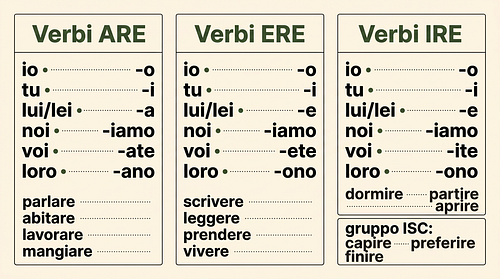
Drop -ire and add the endings -o, -i, -e, -iamo, -ite, -ono.
| Person | dormire (to sleep) | partire (to leave) | aprire (to open) |
|---|---|---|---|
| io | dormo | parto | apro |
| tu | dormi | parti | apri |
| lui/lei/Lei | dorme | parte | apre |
| noi | dormiamo | partiamo | apriamo |
| voi | dormite | partite | aprite |
| loro | dormono | partono | aprono |
Other common verbs of this group: sentire (to hear, to feel), servire (to serve, to be needed), seguire (to follow), offrire (to offer), soffrire (to suffer), vestire (to dress), coprire (to cover), scoprire (to discover), fuggire (to flee).
Pattern two: finire (with -isc-)
Here -isc- appears between stem and ending in io, tu, lui/lei and loro. In noi and voi it is absent: Treccani describes exactly this, listing the singular persons and the third plural as the ones that take -isc- and leaving noi and voi out.
| Person | finire (to finish) | capire (to understand) | preferire (to prefer) |
|---|---|---|---|
| io | finisco | capisco | preferisco |
| tu | finisci | capisci | preferisci |
| lui/lei/Lei | finisce | capisce | preferisce |
| noi | finiamo | capiamo | preferiamo |
| voi | finite | capite | preferite |
| loro | finiscono | capiscono | preferiscono |
More very common verbs: pulire (to clean), costruire (to build), spedire (to send), guarire (to recover), punire (to punish), restituire (to give back), suggerire (to suggest), obbedire (to obey). The Crusca also explains why noi and voi have no -isc-: in the forms with -isc- the stress falls on that element (finìsco, finìsci, finìsce, finìscono), while in finiàmo and finìte the stress already sits on the ending.
The same applies to the “tu” imperative: finisci!, capisci!, pulisci!, as the Treccani grammar notes.
How do I know which group a verb belongs to?
There is no foolproof rule to predict whether a new verb behaves like dormire or like finire. Three habits work well:
- Learn the verb with its first person: write “partire – parto”, “capire – capisco”, not just the infinitive.
- Check a dictionary in the beginning: good dictionaries show the pattern (often with the form “-isco”).
- Keep two lists and add each new verb to the right one. The -isc- group is much larger, but the verbs without -isc- are among the most frequent in conversation.
Watch out for verbs that accept two forms. Treccani mentions, for example, mentire (io mento / io mentisco), inghiottire, nutrire, assorbire and applaudire: both forms are correct, but it is usually best to choose one and use it consistently.
Three irregular verbs to know right away
A few -ire verbs change their stem and have to be memorised separately. The three most frequent are:
| Person | uscire (to go out) | venire (to come) | dire (to say) |
|---|---|---|---|
| io | esco | vengo | dico |
| tu | esci | vieni | dici |
| lui/lei/Lei | esce | viene | dice |
| noi | usciamo | veniamo | diciamo |
| voi | uscite | venite | dite |
| loro | escono | vengono | dicono |
Notice that in all three the “noi” and “voi” forms are more regular than the others, a tendency that helps memory. Salire (salgo) also has a special pattern, but you will meet it later.
The most frequent slips
People who think in German look for a single rule and find it hard to accept that there are two models; French speakers have a small advantage, because French “finir” also has an extra element (finissons) and the ear recognises it. Mistakes are welcome: they show us where we are stumbling. Here are the most common ones:
- Io finio. → Io finisco. You cannot skip -isc- with “io”.
- Noi finiscamo. → Noi finiamo. With “noi” and “voi” there is no -isc-.
- Io capo. → Io capisco. “Capo” exists, but as a noun (the boss, the head).
- Loro dormino. → Loro dormono. The third-person plural ending of -ire verbs is always -ono.
- Tu partisci. → Tu parti. Do not add -isc- to verbs of the first pattern.
Mini-dialogue: leaving for the weekend
Anna: Quando parti per Lugano?
Marco: Parto venerdì sera. Tu preferisci il treno o la macchina?
Anna: Preferisco il treno. Così dormo un po’ e finisco il libro.
Marco: Capisco! Io invece non dormo mai in viaggio. Esco di casa alle sei e arrivo per cena.
Anna: Allora ci vediamo sabato: vengo a prenderti io alla stazione.
Translation: When are you leaving for Lugano? – I leave Friday evening. Do you prefer the train or the car? – I prefer the train. That way I can sleep a bit and finish my book. – I see! I never sleep when I travel. I leave home at six and arrive for dinner. – Then see you Saturday: I’ll come and pick you up at the station.
In the dialogue you will find verbs of the first pattern (parti, parto, dormo, esco, vengo) and of the second (preferisci, preferisco, finisco, capisco). Try underlining them and sorting them into two columns.
Test yourself
Exercise 1 – Fill in the present tense
- Io non (capire) ______ questa parola.
- Il treno (partire) ______ alle otto.
- Noi (finire) ______ il lavoro alle cinque.
- Tu (preferire) ______ il tè o il caffè?
- Voi (dormire) ______ ancora?
- I bambini (pulire) ______ la stanza.
- Lei (uscire) ______ ogni sera con il cane.
- Loro (venire) ______ alla festa?
Answers: 1. capisco; 2. parte; 3. finiamo; 4. preferisci; 5. dormite; 6. puliscono; 7. esce; 8. vengono.
Exercise 2 – Which form is correct?
- Io (apro / aprisco) la finestra.
- Voi (finite / finiscete) il compito?
- Lui (sente / sentisce) un rumore.
- Noi (costruiamo / costruiscono) un modellino.
Answers: 1. apro; 2. finite; 3. sente; 4. costruiamo.
Exercise 3 – Correct the mistake
- Io finio alle sei.
- Noi preferiscamo la pizza.
- Loro dormino bene.
Answers: 1. Io finisco alle sei. 2. Noi preferiamo la pizza. 3. Loro dormono bene.
Think about it for a moment
- Which -ire verbs do you use most often in your day? Do they belong to the dormire group or the finire group?
- Does your language have verbs that change form only in some persons? How do you learn them?
- Can you write five sentences about yourself using at least three -ire verbs?
Pairs to repeat aloud
Repeat the pairs “finire – finisco” and “dormire – dormo” aloud for a few days, each with a personal example. It works better than a table studied once, because your ear gets used to the sound of -isco. When -ire verbs start to feel safe, move on to reflexive verbs (many are in -are, but divertirsi, vestirsi and sentirsi are in -ire). To get used to the adverbs that go with daily actions, read about Italian adverbs of frequency too.
Want to hear how it sounds?
Saying it out loud is the best way: book a free trial lesson, take the level test and join the course waiting list, which is open.
Sources
- Treccani – “Terza coniugazione”, in La grammatica italiana (2012)
- Accademia della Crusca, Consulenza linguistica – “Coniugazione dei verbi come capire, obbedire, ecc.” (M. Cainelli, 11 July 2008)
The rules on the two models and the stress come from Treccani and the Crusca (sources above). The tables, irregular verbs, dialogue and exercises are my own and come from what I see when correcting homework.
📚 Further reading
To practise this point with graded exercises and an answer key, I recommend:
- Italian Grammar in Practice (Susanna Nocchi, Alma Edizioni) – rules explained in English, with exercises, tests and games.
- Practice Makes Perfect: Complete Italian All-in-One (Marcel Danesi, McGraw Hill) – grammar and vocabulary in one workbook, with plenty of exercises.
Affiliate links · As an Amazon Associate I earn from qualifying purchases.