🇮🇹 Leggi questo articolo in italiano
“La mia sorella” or “mia sorella”? “Il mio papà” or “mio papà”? And why do we say “il loro fratello” but “mio fratello”? Italian possessive adjectives look easy (they are just “my, your, his”), but the article that goes with them trips up even intermediate students. Here I walk you through the forms, the general rule, the most important exceptions with family words, and the mistakes I correct most often, with a short dialogue and exercises with answers. The rules come from Treccani’s Enciclopedia dell’italiano and from the language advice service of the Accademia della Crusca (sources at the end); the examples and exercises are mine.
The forms: mio, tuo, suo, nostro, vostro, loro
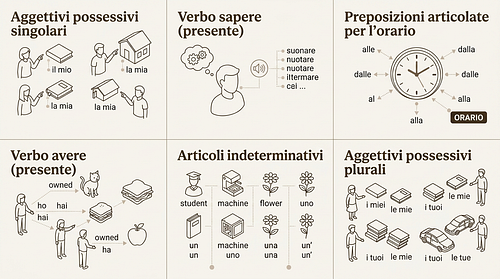
In Italian the possessive adjective agrees with the thing possessed, not with the owner. According to Francesca Ramaglia’s entry in the Enciclopedia dell’italiano, possessive adjectives and pronouns have the same forms: mio, tuo, suo, nostro, vostro (each with feminine and plural forms) and loro, which never changes.
| Owner | masc. sing. | fem. sing. | masc. plur. | fem. plur. |
|---|---|---|---|---|
| io (my) | mio | mia | miei | mie |
| tu (your) | tuo | tua | tuoi | tue |
| lui / lei / Lei (his, her, formal your) | suo | sua | suoi | sue |
| noi (our) | nostro | nostra | nostri | nostre |
| voi (your, plural) | vostro | vostra | vostri | vostre |
| loro (their) | loro | loro | loro | loro |
One point confuses English speakers: in the third person suo means both “his” and “her”. As Treccani points out, there is a single base form, so the gender of the owner is not shown. “Sua madre” can be his mother or her mother, and the context decides. When the risk of misunderstanding is high, the same entry recommends proprio instead of suo when it refers back to the subject of the sentence: Matteo ha visto il proprio vicino (Matteo’s own neighbour, not somebody else’s).
The general rule: the article is there
Unlike English, French, Spanish and German, Italian normally puts the article before the possessive (Treccani makes this point):
- il mio libro, la tua casa, i suoi amici, le nostre idee;
- un mio amico, una tua collega: with the indefinite article the order changes and the possessive comes after it (“a friend of mine”).
Pronouns work the same way: Il mio è rosso, il tuo è blu (speaking about two backpacks).
The key exception: singular family words
With family words in the singular the article is normally left out: mio fratello, tua figlia, nostra nonna. In the plural the article comes back: i miei fratelli, le tue figlie, i nostri nonni. With loro the article is always there, even in the singular: il loro fratello. That is Treccani’s summary. The Crusca (answer by Marina Bongi, 2008) adds the details that matter most in class:
- padre, madre, figlio, figlia: no article. “Il mio padre” is considered incorrect, while with an adjective (“la mia figlia maggiore”) it is acceptable;
- affectionate forms (papà, babbo, mamma, nonno, nonna): the article is normal, so “la mia mamma” and “il mio papà” are correct; in everyday Italian outside Tuscany, however, “mia mamma” and “mio papà” prevail;
- diminutives and altered forms (sorellina, nonnino) and patrigno, matrigna, figliastro, figliastra: the article is required (la mia sorellina);
- romantic relationships that are not family: il mio fidanzato, la mia ragazza;
- emphasis: when the possessive follows the noun, the article is there (il figlio mio).
Some nouns do not take an article even without a possessive, such as casa in a casa mia, a casa tua (“at my place”), another point made by Treccani.
Where does the possessive go?
The normal position is before the noun (il tuo telefono). After the noun (gli amici tuoi) the effect is emphatic or contrastive; in the regional Italian of central and southern Italy, placing it after the noun is simply normal (as Treccani reports). In exclamations and when addressing someone, the possessive always follows: Figli miei!, Amico mio!, Mamma mia!.
The mistakes I correct most often
People who think in German or French tend to copy their own language, and the article before the possessive is the classic trap. Mistakes are welcome: we correct them together, one at a time. And yes, even “oh, mamma mia!” is a possessive placed after the noun. Here are the most frequent slips:
- La mia sorella è medico. → Mia sorella è medico. (singular family word, not a diminutive)
- Mio fratelli sono simpatici. → I miei fratelli sono simpatici. (plural: the article is compulsory)
- Loro fratello vive a Milano. → Il loro fratello vive a Milano. (with “loro” the article is always there)
- Anna dice a Marta che sua madre arriva domani. → whose mother, Anna’s or Marta’s? If you want to be clear, repeat the name: la madre di Anna.
- Lo mio zaino. → Il mio zaino. With a possessive the article is chosen by the possessive, not by the noun: “lo zaino”, but “il mio zaino”.
- Mia casa è grande. → La mia casa è grande. (leaving out the article works for a casa mia, not for every sentence with “casa”)
Mini-dialogue: a family photo
Giulia: Chi sono queste persone nella foto?
Paolo: Questa è mia madre, e questo è mio padre. Qui ci sono i miei fratelli.
Giulia: E la ragazza con il cappello?
Paolo: È la mia ragazza, Elena. Sua sorella abita vicino a casa nostra.
Giulia: Che bella la vostra famiglia! E il cane è vostro?
Paolo: No, è il cane dei miei nonni: il loro cane vive con noi d’estate.
Translation: Who are these people in the photo? – This is my mother, and this is my father. Here are my brothers. – And the girl with the hat? – She’s my girlfriend, Elena. Her sister lives near our house. – What a lovely family you have! Is the dog yours? – No, it’s my grandparents’ dog: their dog lives with us in summer.
Your turn
Exercise 1 – With or without the article?
Fill in the gap with the possessive and, if needed, the article.
- (io) ______ madre lavora in banca.
- (tu) ______ fratelli abitano a Roma?
- (noi) ______ nonno ha ottant’anni.
- (loro) ______ figlia studia medicina.
- (io) ______ sorellina ha sei anni.
- (voi) ______ amici sono arrivati.
Answers: 1. Mia madre; 2. I tuoi fratelli; 3. Nostro nonno; 4. La loro figlia; 5. La mia sorellina; 6. I vostri amici.
Exercise 2 – Answer the question
Use the right possessive.
- Di chi è questa borsa? (di Anna) → È ______ borsa.
- Di chi sono quei libri? (di voi) → Sono ______ libri.
- Di chi è il gatto? (di Luca e Marta) → È ______ gatto.
Answers: 1. la sua; 2. i vostri; 3. il loro.
Exercise 3 – Find the mistake
- La mia fratello è alto.
- Loro madre è gentile.
- Mio sorelle abitano a Torino.
Answers: 1. Mio fratello è alto. 2. La loro madre è gentile. 3. Le mie sorelle abitano a Torino.
Stop for a moment
- In your language, does the possessive take an article? In which sentences is Italian different?
- Do you hear “mia mamma” or “la mia mamma” more often? Does it depend on where people are from?
- Can you describe your family in six sentences using at least four different possessives?
Three blocks to repeat aloud
It is better not to learn the article rule as a list, but as three blocks to repeat aloud: mia madre, mio fratello, nostra nonna (singular family words); i miei fratelli, le mie sorelle (plural); il mio libro, la mia casa (everything else). To describe the people in your family you can reuse Italian personality adjectives; if you have children, the school vocabulary for parents will also help. And if you want a refresher on the present tense for your sentences, read the guide to Italian -ire verbs.
Shall we go over it together?
If you prefer to do it out loud, book a free trial lesson, take the level test and join the course waiting list, which is open.
Sources
- Treccani – F. Ramaglia, “Possessivi, aggettivi e pronomi”, Enciclopedia dell’italiano (2011)
- Accademia della Crusca, Consulenza linguistica – “Uso dell’articolo e dell’aggettivo possessivo coi nomi di parentela” (M. Bongi, 6 June 2008)
For forms, article and position I relied on Treccani; for family words, on the Crusca’s advice. The tables, dialogue and exercises are my own and come from what I see when correcting homework.
📚 Further reading
To practise this point with graded exercises and an answer key, I recommend:
- Italian Grammar in Practice (Susanna Nocchi, Alma Edizioni) – rules explained in English, with exercises, tests and games.
- Practice Makes Perfect: Complete Italian All-in-One (Marcel Danesi, McGraw Hill) – grammar and vocabulary in one workbook, with plenty of exercises.
Affiliate links · As an Amazon Associate I earn from qualifying purchases.